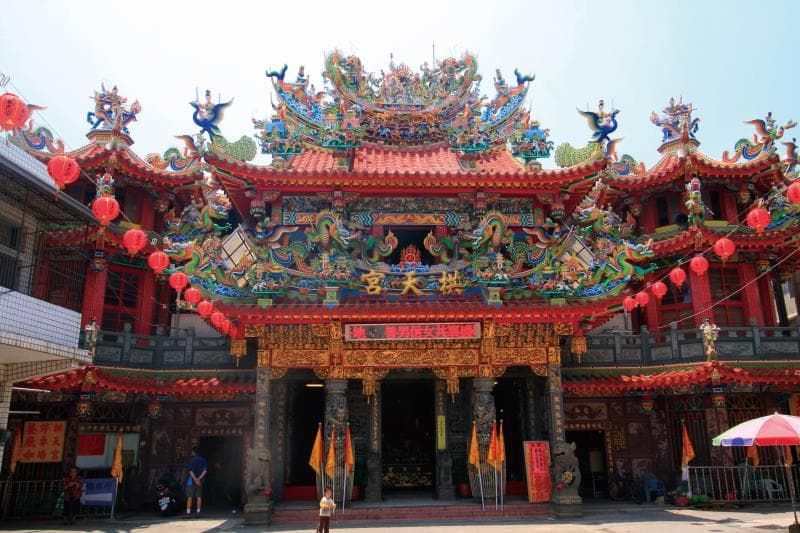
Baishatun Gongtian Temple
During the Qianlong reign of the Qing dynasty, early settlers invited a 'soft-bodied' Mazu statue and enshrined it in private homes. Later, in the second year of the Tongzhi reign, a temple was built for her enshrinement…
Visitor Essentials
每日開放
During the Qianlong reign of the Qing dynasty, early settlers invited a 'soft-bodied' Mazu statue and enshrined it in private homes. Later, in the second year of the Tongzhi reign, a temple was built for her enshrinement, which became known as "Gongtian Temple." Locals refer to her as "Baishatun Mazu." Gongtian Temple has a magnificent appearance, with intricate and colorful Koji pottery decorations on its roof and gold-leaf gilded exterior eaves. It is splendid and grand, exuding an impressive aura. Year after year, the Baishatun Mazu walking pilgrimage has continued for over a century. Compared to other existing Mazu pilgrimage activities across Taiwan, the history of this event is even older. Beyond its religious significance, in today's bustling Taiwanese society, another captivating aspect of the Baishatun Mazu walking pilgrimage is the unreserved human warmth and camaraderie shared among people in the pilgrimage procession. For a long time, due to Baishatun's remote location, its residents lived simple and frugal lives. Consequently, the annual pilgrimage to Beigang had to be undertaken in the most arduous way: on foot. Over time, the honest and kind early settlers of Baishatun developed a spirit of enduring hardships and supporting each other along the pilgrimage route, forming a unique cultural landscape. Today, when one walks among the Baishatun Mazu pilgrimage procession, one can naturally feel a rich sense of human warmth – a treasure passed down through generations by Baishatun's early settlers, under the guidance of Mazu. Walking the Entire Journey, The Palanquin Determines Its Own Route Compared to other Mazu pilgrimage activities across Taiwan, the most talked-about aspect of the Baishatun Mazu pilgrimage is its route, whose path is entirely decided by the palanquin. Many devotees deeply believe that there are no human-controlled factors involved, and that it is truly guided by divine will on its journey to Beigang. Under divine guidance, devotees not only realize their own insignificance but also learn to humbly observe the events around them. Especially when hungry, receiving items offered by passersby—be it a cup of water, a bowl of porridge, or even a warm greeting or a word of encouragement—leaves one deeply grateful. Many who join the Baishatun Mazu pilgrimage procession will surely return to participate the following year, as such a rich and unique cultural landscape is truly unparalleled in Taiwan. It is a pilgrimage that every Taiwanese person must experience once in their lifetime.
Discover the Context
No stories linked yet.