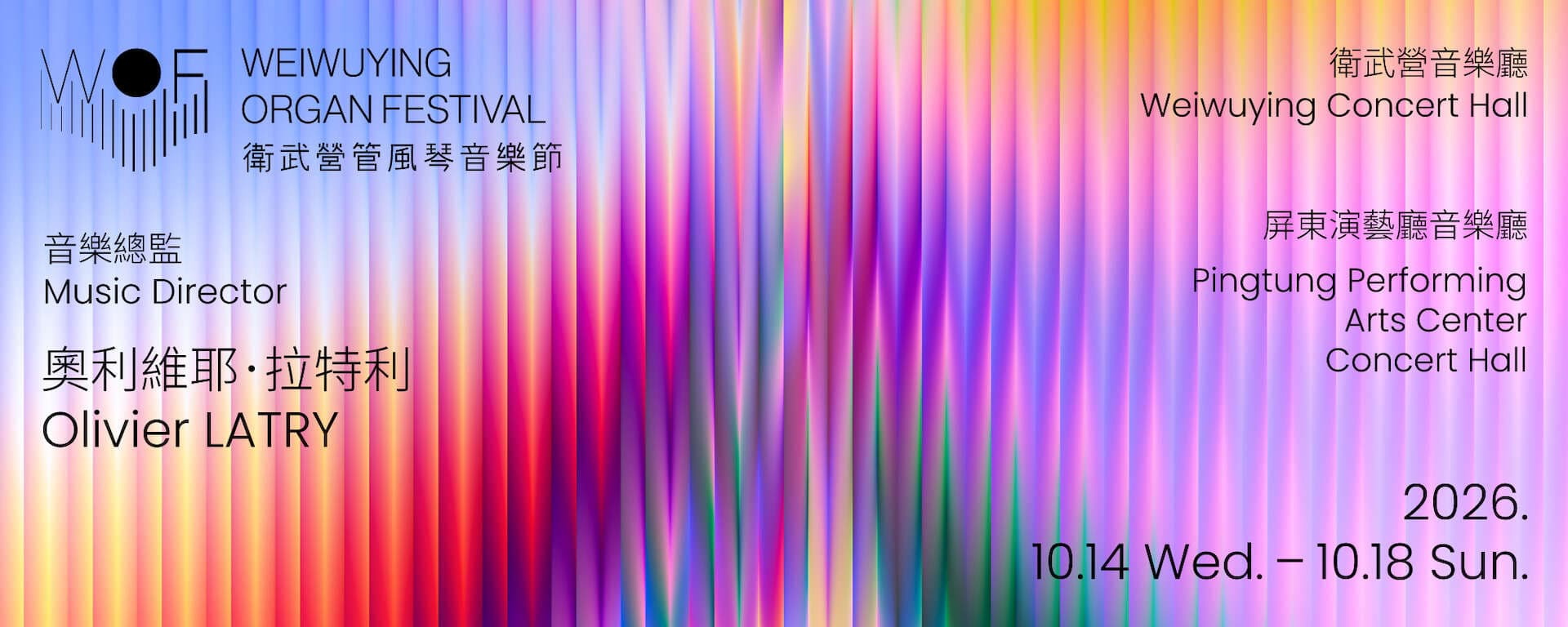
2026 Weiwuying Organ Festival
When
Oct 13 - 18, 2026
Where
高雄市
Through the Stone Walls of the Sanctuary ~ Olivier Latry's Echoes of the Century In 1258, after nearly a century of construction, Notre Dame de Paris was finally completed, becoming a political and cultural landmark of France. Its pipe organ, which has stood witness since 1330, miraculously survived revolutionary upheavals and the devastating fire of 2019. Its evolution in the 19th century magnificently transformed it, defining the timbre of the French 'symphonic organ,' laying the foundation for the French school, and earning it the epithet 'The Voice of Notre Dame.' Today, this guardian of 8,000 pipes, who is also the Weiwuying Organ Consultant – Olivier Latry – is the curatorial core of the '2026 Weiwuying Organ Festival.' Latry is not only a world-leading organ master but also a core inheritor of the French organ school. Appointed at the age of 23, he became Notre Dame's longest-serving principal organist. After the fire, he personally undertook the voicing and tuning of the 8,000 pipes and completed the post-disaster premiere at the reopening ceremony at the end of 2024, profoundly moving the world once again with 'The Voice of Notre Dame' after five years of silence. The three programs curated by Latry profoundly reveal his mission as an inheritor of 'The Voice of Notre Dame': The first concert, 'Bach's Visions' (Pingtung Performing Arts Center), focuses on the French school's reinterpretation of Bach by several predecessors, showcasing the school's unique coloristic tension and improvisational skill. Returning to Weiwuying, 'Summit Dialogue' features a symphonic conversation between Asia's largest pipe organ and an orchestra, challenging the sonic limits of contemporary works. 'Concerted Harmony' will feature him and his wife, Shin-Jung Lee, unleashing the breathtaking power of 'The Rite of Spring' in a four-hand organ duet as the grand finale. From Notre Dame to Weiwuying, Latry's organ music transcends church sanctuaries, resonating in concert halls. The programs span three centuries, guiding the audience to appreciate the various expressive perspectives of this colossal instrument, delving into its sonic dimensions. The recontextualization of these works transforms into a continuously evolving sensory experience. Thus, the pipe organ is no longer merely a historical heritage but an evolving artistic language.