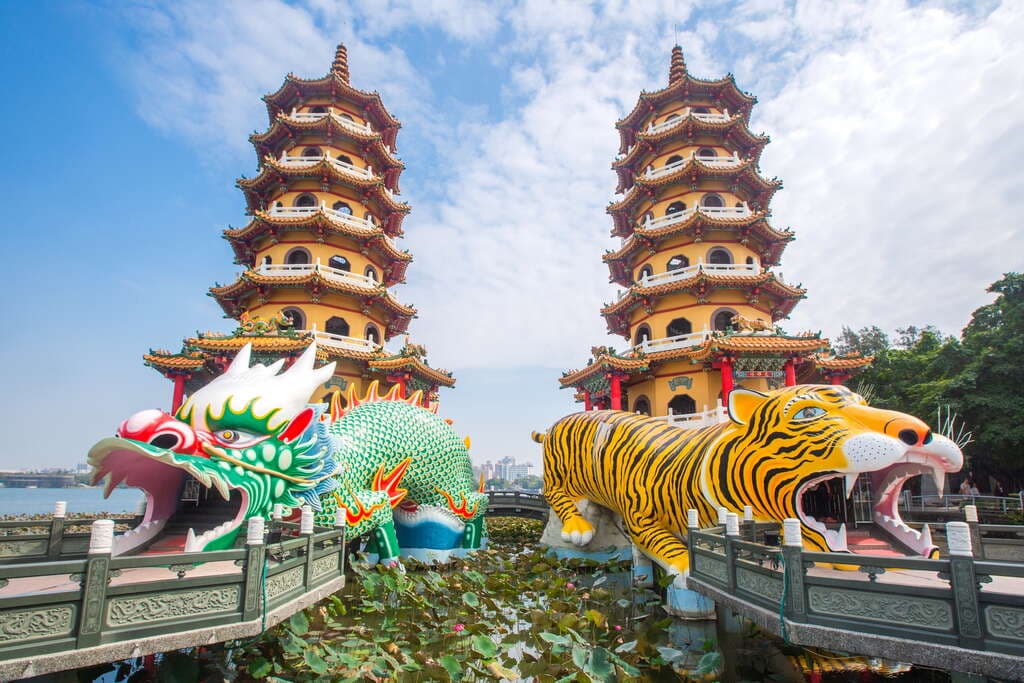
Lotus Pond
Lotus Pond was formerly known as Lotus Lake, located on the eastern side of Zuoying District, Kaohsiung City. It is bordered by Guishan (Turtle Mountain) to the south and Banpingshan (Half-Screen Mountain) to the north.…
Visitor Essentials
Lotus Pond was formerly known as Lotus Lake, located on the eastern side of Zuoying District, Kaohsiung City. It is bordered by Guishan (Turtle Mountain) to the south and Banpingshan (Half-Screen Mountain) to the north. The lake covers an area of approximately 42 hectares and is fed by the Gaoping River. Due to the abundance of lotus flowers planted around its waters, Lotus Pond was listed as one of the Eight Scenic Spots of Fongshan during the Qing Dynasty, known as 'Panshui Hexiang' (Lotus Fragrance on the Lake). Today, it is famous for 'Lotus Lake Sunset,' owing to the unique shape of Banpingshan on its shore and the reflection of the Dragon and Tiger Pagodas in the water from afar. At night, Lotus Pond is often shrouded in mist, creating a hazy and elusive scene that evokes an ineffable sense of mystery. Pavilions and pagodas stand along the lake, and weeping willows are abundant on its banks, creating a beautiful scenery. Scenic spots from south to north include the Old City Wall, Dragon and Tiger Pagodas, Wuli Pavilion, Spring and Autumn Pavilions, Qiming Temple, and the Confucius Temple, attracting tourists from all over. On holidays, it is especially bustling with visitors. The Spring and Autumn Pavilions, built in 1953 (the 42nd year of the Republic of China), are a pair of palace-style pagodas, collectively known as the Spring Pavilion and Autumn Pavilion. Each is a four-story, octagonal structure with green tiles and yellow walls, resembling ancient pagodas. Their antique charm is reflected in the water, and their design was considered a pinnacle among Taiwanese pagodas at the time. They are connected by a Nine-Turn Bridge and are also known as the 'Spring and Autumn Imperial Pavilions,' built in honor of Guan Gong, the God of War. At the front of the Spring and Autumn Pavilions stands a statue of Guanyin Riding a Dragon. There is a legend about the origin of this statue: Guanyin Bodhisattva once appeared riding a dragon in the clouds, instructing devotees to build a sacred image between the Spring and Autumn Pavilions in the form of her apparition, leading to the current statue of Guanyin Riding a Dragon. The Dragon and Tiger Pagodas are seven stories high, with two twin pavilions resembling a dragon and a tiger rising from the lake. Each pavilion has a dragon or tiger sculpture at its front. Visitors can enter through the dragon's mouth and exit through the tiger's mouth, symbolizing good fortune. The pagodas are connected to the shore by a Nine-Turn Bridge, standing majestically and mirroring the lake, creating a beautiful scene.
Discover the Context
No stories linked yet.
Happening at Lotus Pond
View CalendarNo upcoming events at this venue.