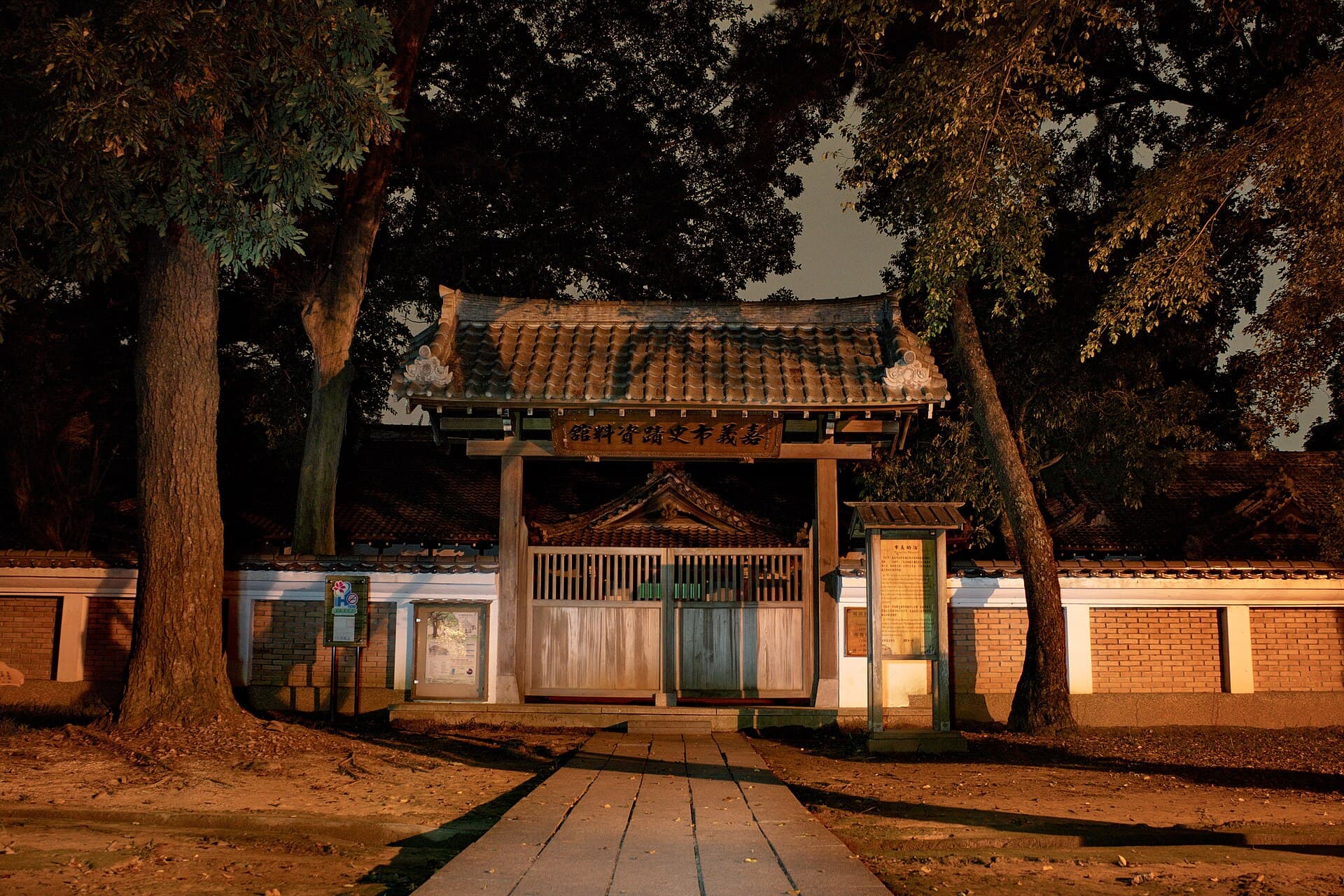
Chiayi City Historical Relics Museum
The two buildings of the Chiayi City Historical Relics Museum were originally the Saikan (purification hall) and Shamusho (shrine office) affiliated with the Chiayi Shrine during the Japanese colonial period. Designated…
Visitor Essentials
The two buildings of the Chiayi City Historical Relics Museum were originally the Saikan (purification hall) and Shamusho (shrine office) affiliated with the Chiayi Shrine during the Japanese colonial period. Designated as a city-level historic site, the Chiayi City Historical Relics Museum was established in 1943. The Saikan was a place for purification and preparation before worshipping at the shrine, while the Shamusho served as the administrative office for the shrine. These two buildings adopt the Japanese "Shoin-zukuri" architectural style, incorporating elements such as ceilings, paper sliding doors, and exterior corridors. The roofs are of the "Irimoya-zukuri" style, similar to the traditional Chinese "Xieshan" (gable and hip) roof, with Japanese architectural elements used for the eaves, ridges, hafu (gable decoration), hip ridges, and main ridge. The upper part of the exterior walls features boat-shaped bracket arms (hijiki), while the lower part employs the "Shin-kabe" (true wall) method. The base is a low stilt-frame construction. Regarding doors and windows, most doors are sliding doors, with only a few being push-pull doors. There are four types of windows: glass sliding windows with fixed grilles, fixed grilles with sliding glass windows, and paper sliding windows. The Saikan, Shamusho, Temizuya (water purification pavilion), and Saikiko (ritual implement storage) are representative examples of Japanese residential culture left behind, with the Saikiko being particularly unique due to its concrete exterior walls imitating wooden architecture. The Saikan has a built area of 267 square meters, and the Shamusho has a built area of 208 square meters. The two buildings are connected by a corridor, forming a considerably sized integrated space with the central corridor as the connecting axis. Overall, the layout, architectural elements, and functional forms of this Japanese "Shoin-zukuri" style construction are extremely rare in Taiwan, making it highly unique. It showcases elegant artistic expression and possesses significant craft reference value. Subsequently, the city government entrusted professional units to complete the restoration and reconstruction of the buildings, adhering to principles such as "not altering the main structure," "preserving the original exterior style," "restoring based on original architectural elements," and "considering integration with the park environment." In October 1998 (Min-guo 87), the Chiayi City Government designated these two buildings as city-level historic sites and named them the "Chiayi City Historical Relics Museum." On September 15, 2001 (Min-guo 90), the Historical Relics Museum officially opened. The museum exhibits stories about the people and events of Chiayi City, interweaving past and present to showcase their respective splendors, thereby inspiring citizens' love for their hometown and family. The Historical Relics Museum is the best place to understand Chiayi's history. To get to know Chiayi, start by visiting the Historical Relics Museum.
Discover the Context
No stories linked yet.
Happening at Chiayi City Historical Relics Museum
View CalendarNo upcoming events at this venue.