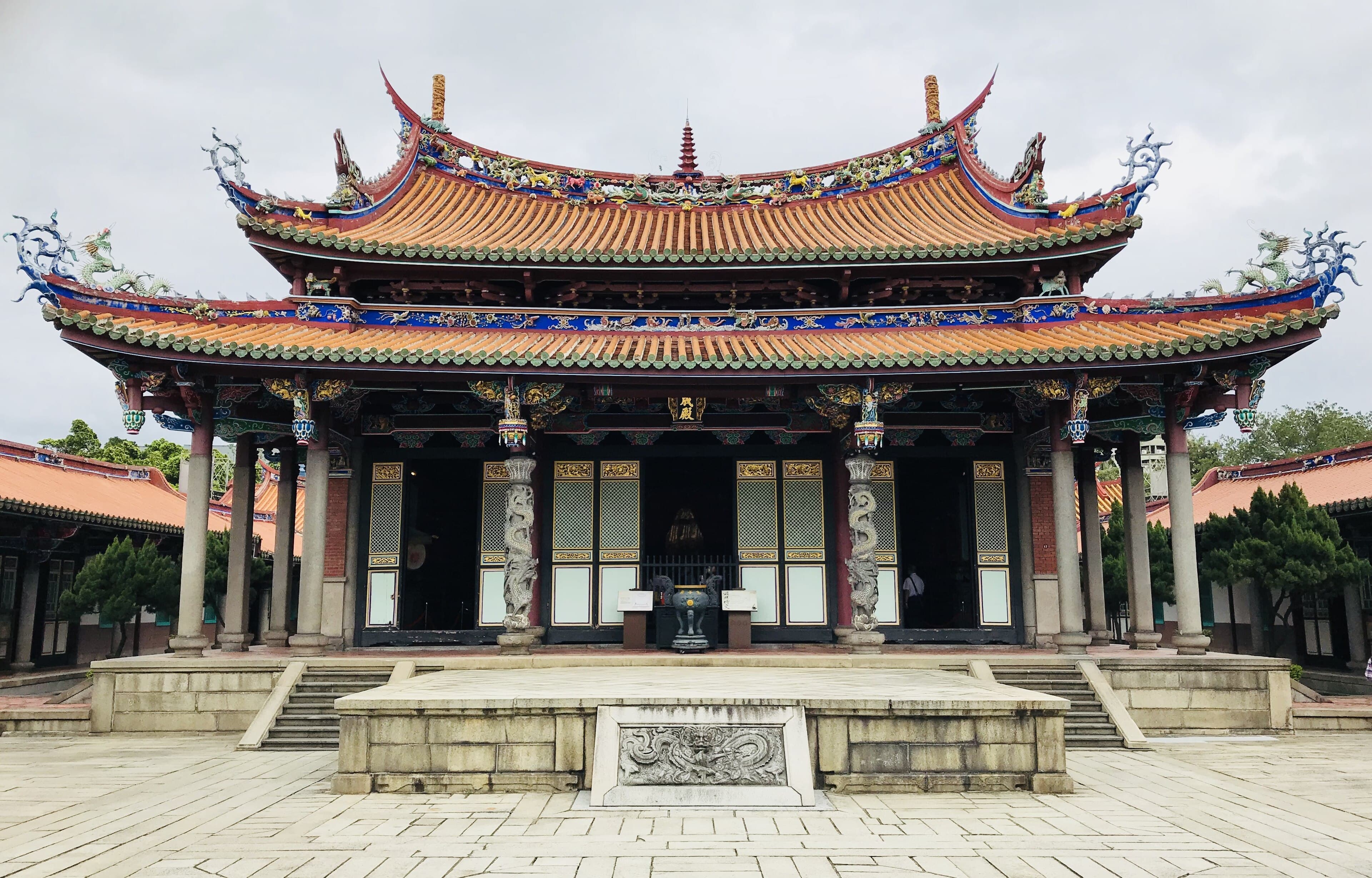
Taipei Confucius Temple
Walk along Dalong Street to reach the Confucius Temple. The temple is primarily dedicated to China's greatest teacher, Confucius, the Great Sage and Teacher, alongside the sages and scholars of past dynasties. As Confuci…
Visitor Essentials
Walk along Dalong Street to reach the Confucius Temple. The temple is primarily dedicated to China's greatest teacher, Confucius, the Great Sage and Teacher, alongside the sages and scholars of past dynasties. As Confucius advocated simplicity, the temple's architecture is notably plain and unadorned, lacking the elaborate decorations typical of other temples. Even the entrance features no stone lions. The temple is centered around the Dacheng Hall (Hall of Great Completion). Standing outside Dacheng Hall, you'll notice a pair of cylindrical structures on the central roof, known as 'Cangjing Tong' (Scripture Storage Cylinders). In ancient Chinese history, Emperor Qin Shi Huang, to consolidate his rule, implemented a policy aimed at keeping the populace ignorant, which included burning books and persecuting scholars. To preserve their texts, scholars of that era constructed chimney-like book storage cylinders on their rooftops to hide their books from destruction. The Confucius Temple similarly incorporates these Cangjing Tong, symbolizing admiration for the scholars' dedication to preserving knowledge. Additionally, on the front roof, there are carvings of owls. While owls were traditionally regarded as unfilial and cruel, Confucius also sought to educate them. Thus, the owl carvings represent Confucius's principle of 'education without discrimination'. Furthermore, between the two sets of stairs, there is a sloping ramp with a dragon relief, called an 'Imperial Pathway' (Yulu). This was historically used by emperors or deities when ascending or descending the hall. Another unique aspect of the Confucius Temple is that, unlike other temples, its pillars, doors, and windows bear no inscriptions. This is said to signify that no one dared to show off their literary prowess in front of the Great Sage and Teacher Confucius. Moreover, the temple contains no statues. Historically, Confucius Temples did house statues of Confucius. However, due to varying carving techniques that sometimes failed to capture Confucius's true essence, Emperor Taizu of the Ming Dynasty decreed that all newly built Confucius Temples should use memorial tablets instead of statues. Later, the Jiajing Emperor of the Ming Dynasty ordered the removal of all Confucius statues nationwide, mandating the exclusive use of memorial tablets. Since then, regardless of dynastic changes, this regulation has been upheld, which, by preventing the deification of Confucius through idols, has instead highlighted the profound greatness of his character. Every year on September 28th, Confucius's birthday is commemorated with a solemn Grand Ceremony for Honoring Confucius held in the early morning. During this ceremony, students perform the Eight-Row Dance on the terrace outside Dacheng Hall to express their profound reverence for Confucius. After the ceremony, many people eagerly pluck 'wisdom hair' (ox hair) for their children or themselves, symbolizing a prayer for their descendants to gain wisdom and achieve smooth academic progress.
Discover the Context
No stories linked yet.
Happening at Taipei Confucius Temple
View CalendarNo upcoming events at this venue.