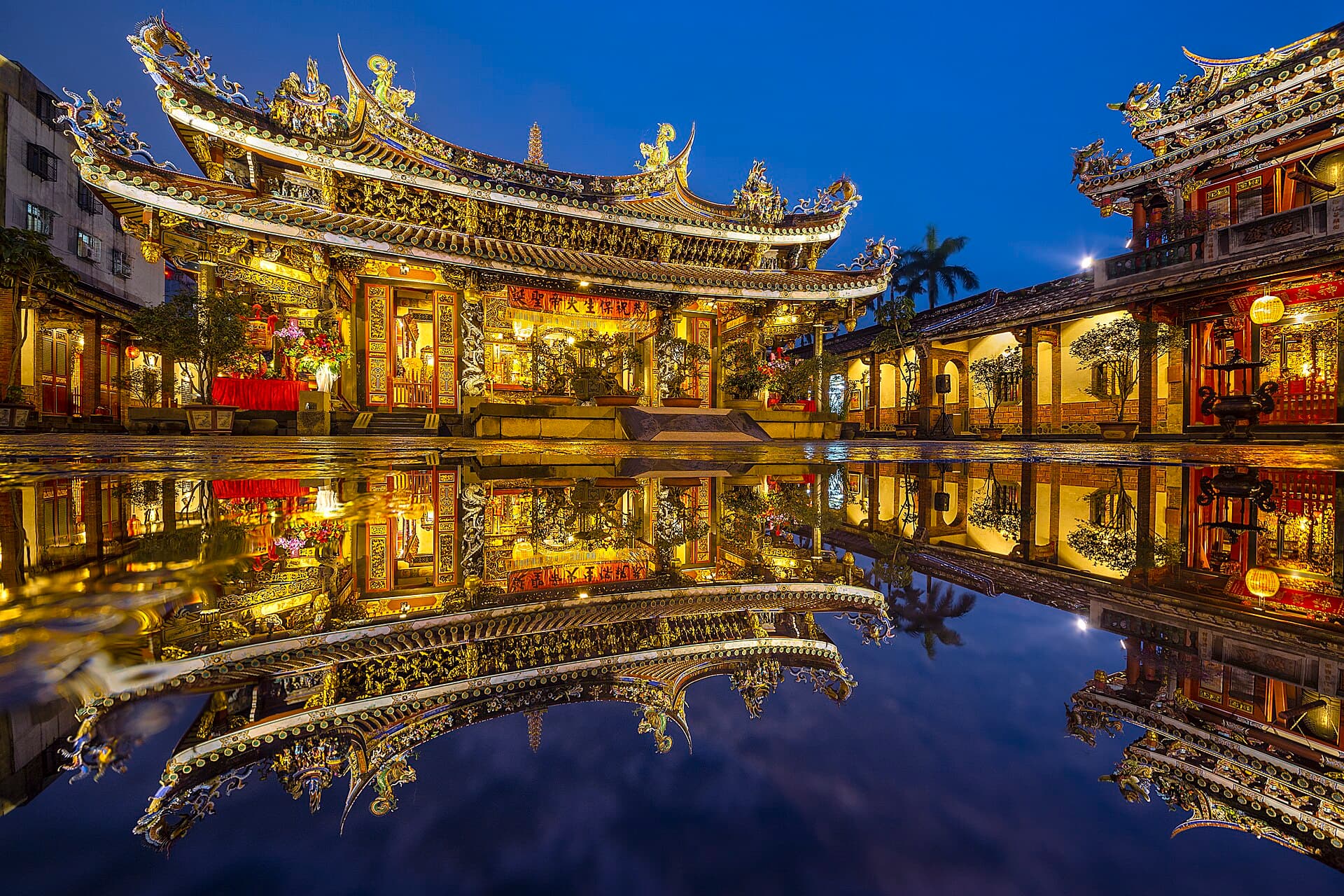
Dalongdong Bao'an Temple
Bao'an Temple covers a vast area and was first built in 1805. Due to the monumental and challenging construction project, all the required stone and timber had to be transported from China, and master craftsmen were spec…
Visitor Essentials
Bao'an Temple covers a vast area and was first built in 1805. Due to the monumental and challenging construction project, all the required stone and timber had to be transported from China, and master craftsmen were specifically invited from there. Therefore, the entire project was carried out in phases and took twenty-five years to complete. Upon arriving at Bao'an Temple, one can see not only dragon pillars but also uniquely shaped stone lions in front of the temple. Typically, temple stone lions come in a pair, one male and one female, with the male's mouth open and the female's mouth closed. However, both stone lions at Bao'an Temple have open mouths. It is said that this pair of 'stone lions' are not actually lions; one embodies benevolence, and the other justice. Placed in front of the temple, they serve as a call to the world to uphold the law and practice benevolent governance. Inside the temple, there are many colorful paintings and sculptures worth admiring. Looking around the corridors in front of the main gate, one can see numerous animal sculptures. Besides their decorative purpose, they also carry deeper meanings: for example, bats represent 'blessings,' four bats symbolize 'bestowing blessings,' deer signify 'prosperity and official status,' and cranes represent 'longevity.' Passing through the courtyard to the main hall, one can see the enshrined deity, Baosheng Dadi, along with his revered ancestral statues. Baosheng Dadi was Wu Ben from Tong'an County, Fujian Province. He was highly skilled in medicine and, in addition to healing people, there are legends of him 'treating a dragon's eye and a tiger's throat.' After his ascension to heaven, the Great Emperor continued to frequently manifest his divine power, eliminating harm and curing illnesses for the people. Thus, Emperor Gaozong of Song built a temple for him in 1151, and Emperor Xiaozong of Song conferred upon him the title 'Da Dao Zhen Ren' (Perfected Person of the Great Dao) in 1171. Therefore, Baosheng Dadi is also known as 'Da Dao Gong' (Lord of the Great Dao). Additionally, enshrined on both sides are statues of 36 celestial generals, carved by the renowned master Xu Yan from Quanzhou, who was invited to Taiwan in 1829. This work took 5 years to complete and is praised for its exquisite craftsmanship and lifelike representations of the deities. At the same time, one can also notice seven colorful murals on the walls, each depicting Chinese folk stories. Directly beneath the Drum Tower, enshrined in the center is Zhusheng Niangniang (Goddess of Childbirth), flanked by twelve Attendant Goddesses (Poji) who each oversee one of the twelve months and are solely responsible for human fertility. In the former agrarian society, there was a belief that 'many sons and grandsons bring many blessings.' Thus, on the birthday of Zhusheng Niangniang, women from near and far would come to worship and pray for her to bestow offspring. The rear hall, also known as Shennong Hall, primarily enshrines Emperor Shennong. It is said that over a century ago, Taipei experienced several months without rain, prompting residents to fervently pray to Shennong for rain. True to their prayers, not long after, a heavy rain fell, alleviating the drought. Therefore, the residents respectfully invited Emperor Shennong to be enshrined in the rear hall of Bao'an Temple.
Discover the Context
No stories linked yet.
Happening at Dalongdong Bao'an Temple
View CalendarNo upcoming events at this venue.