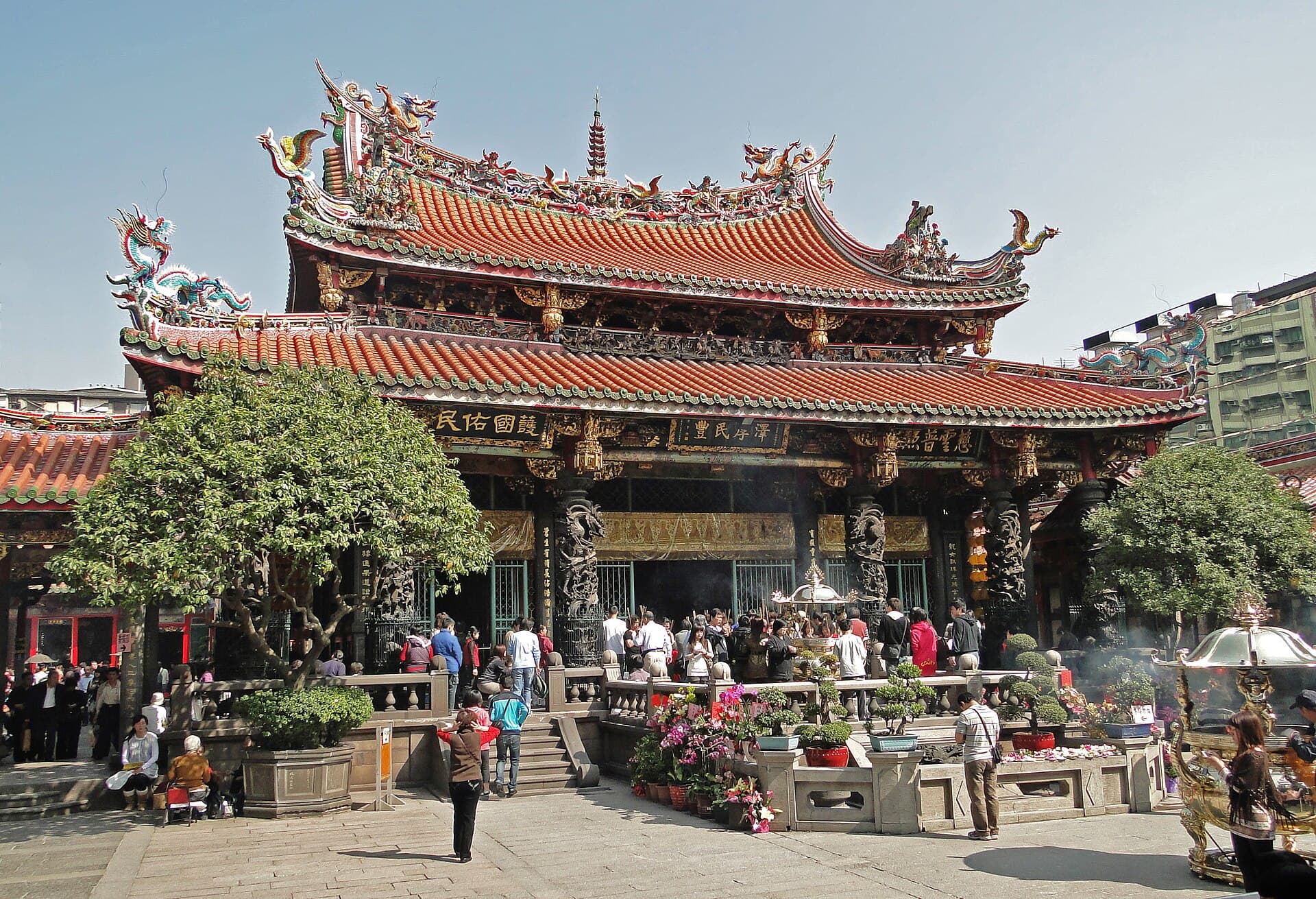
Longshan Temple, Taipei
Monga (today's Wanhua) is the earliest developed area in Taipei City. Longshan Temple, Taipei's premier temple, served as the center for local residents' faith, activities, gatherings, and even command. Legend has it tha…
Visitor Essentials
Monga (today's Wanhua) is the earliest developed area in Taipei City. Longshan Temple, Taipei's premier temple, served as the center for local residents' faith, activities, gatherings, and even command. Legend has it that a long time ago, someone accidentally left a Guanyin Bodhisattva incense pouch hanging on a large banyan tree, and at night, it mysteriously glowed. Even stranger, it granted every wish and was incredibly efficacious. Therefore, devotees built Longshan Temple on that spot, starting in 1738 AD and completing it in 1740 AD. Over two hundred years, Longshan Temple has undergone numerous renovations. Its entire structure is in the shape of a complete 'Hui' (回) character, a highly esteemed layout in traditional temple architecture. In the plaza, one can observe the stone materials used for the flooring; the parts with less regular cuts have an ancient history. In the past, the Taiwan Strait was also known as the 'Black Ditch' (黑水溝) due to its strong winds and high waves. Immigrants used stone slabs to weigh down their ship holds, ensuring a safe journey to Taiwan. These very stone slabs were later used to pave parts of the plaza in front of Longshan Temple. Next, you can begin your appreciation from the front hall. First, you'll see Taiwan's unique bronze dragon pillars, cast in 1918, in front of the hall. The wood carvings and colorful paintings under the eaves are also remarkably vivid. Especially noteworthy are the 'net-like dougong brackets' (網目斗拱) supporting the roof, which were a first in Taiwanese temple architecture. Additionally, the stone-carved window on the left side of the main entrance features splendid scenes from the Romance of the Three Kingdoms; on the right, there's an octagonal bamboo-joint window carved with bamboo stalks, signifying 'peace and safety' (竹報平安). Since the main entrance is only opened during festivals and ceremonies, visitors usually enter through the left gate and exit through the right gate. Inside the temple, you can witness many devotees devoutly worshiping, chanting sutras, and reciting prayers. After exiting the front hall, in the courtyard (tianjing), there's an incense burner featuring an amusing sculpture of 'Humble Barbarians Lifting Temple Corners' (憨番抬廟角). On either side of the courtyard are a bell tower and a drum tower, which are rung in the morning and beaten in the evening to signal and remind of scripture chanting and Dharma assemblies. Ascending the stone steps to the main hall, you'll find a corridor surrounding it on all four sides. The walls and stone pillars along this corridor feature intricate stone carvings, well worth a close look. Inside the main hall, you can see the principal deity, Guanyin Bodhisattva. During World War II, Longshan Temple's main hall was hit by artillery fire, completely destroying the structure. However, the statue of Guanyin Bodhisattva remained entirely unscathed, leading devotees to worship her even more reverently. Upon reaching the rear hall and the left and right wing halls, you'll encounter numerous deities and Buddhas. Some say that 'Longshan Temple is a gathering place for all gods,' meaning that the temple houses a vast number of deities; there are over a hundred main and secondary deities. Here, pay attention to the pair of human-figure stone pillars in front of the rear hall, which are vividly sculpted and differ from the dragon-themed pillars typically found in other temples. Furthermore, on the outer walls near the entrances to the left and right halls, there are stone carvings of 'Red-haired Barbarians Blowing Conch Shells' (紅毛番吹法螺), sharing a similar playful charm with the 'Humble Barbarians Lifting Temple Corners' on the incense burner. Longshan Temple not only houses numerous artistic treasures but also hosts several lively festivals throughout the year. It's well worth a visit to broaden your horizons.
Discover the Context
No stories linked yet.
Happening at Longshan Temple, Taipei
View CalendarNo upcoming events at this venue.