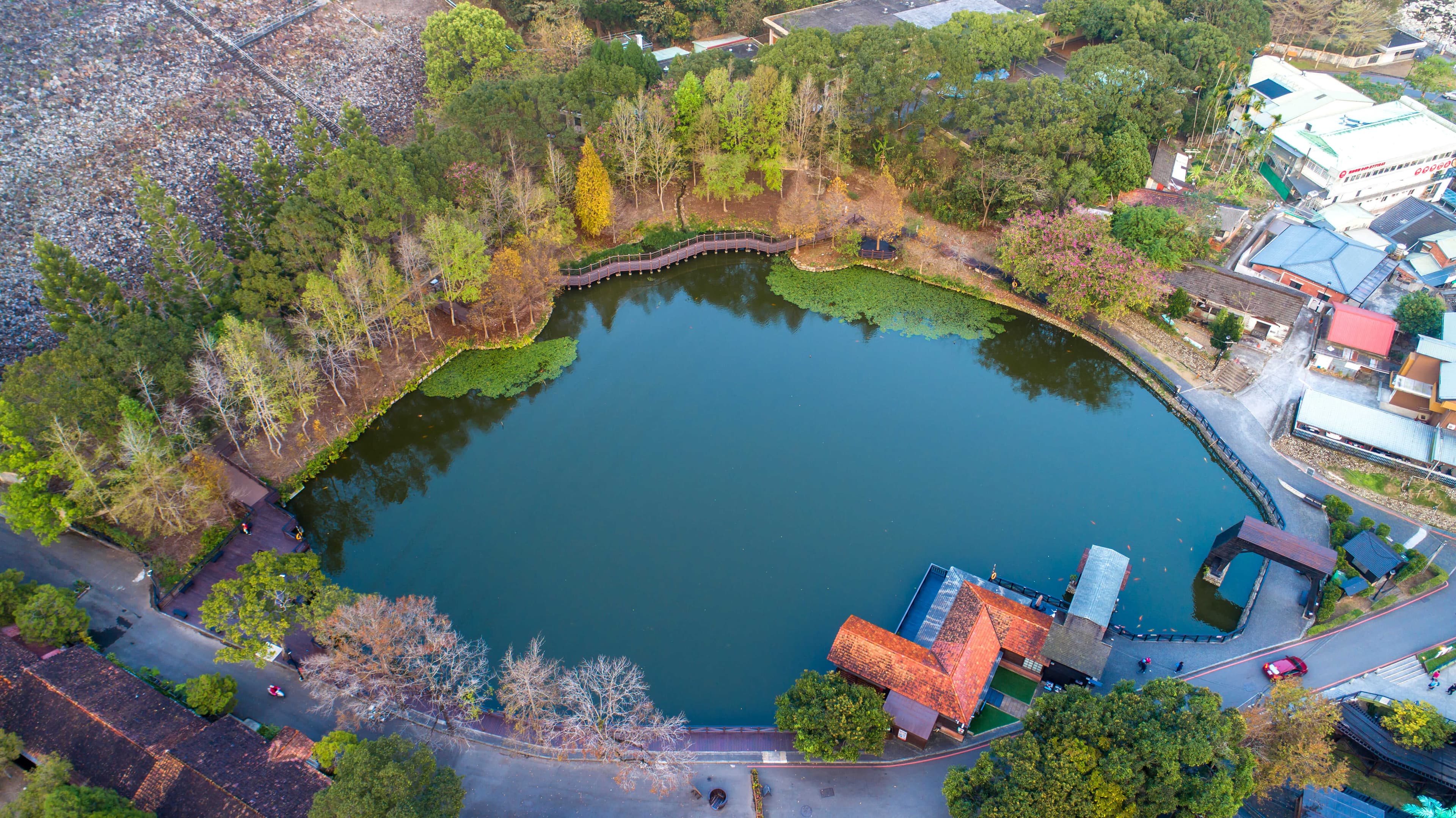
Checheng Recreational Area
Checheng Station is the origin and terminus of the Jiji Line. After the last train arrives at Checheng, the conductor and railway staff rest in the staff dormitory and depart the next day. The train is then parked in the…
Visitor Essentials
Checheng Station is the origin and terminus of the Jiji Line. After the last train arrives at Checheng, the conductor and railway staff rest in the staff dormitory and depart the next day. The train is then parked in the maintenance depot for upkeep and repairs. The Sun Moon Lake National Scenic Area Administration renovated the former railway warehouse, which used to store miscellaneous items, along with surrounding railway facilities and shops, creating a railway cultural park. The Japanese-style staff dormitory was renovated according to its original architectural appearance, restoring the living scenes of the railway station master and employees at that time, allowing visitors to experience Japanese lifestyle aesthetics. At the same time, the remains of the maintenance depot were preserved, allowing visitors to experience the scenes of yesteryear. Introduction to Old Carriages: 1. American GM-EMD-S300 Diesel Shunting Locomotive Acquired by Taiwan Railways (TRA) in 1966 (Republic of China year 55), it was a lightweight shunting locomotive model for TRA, and also the most numerous type of diesel shunting locomotive. It had a top speed of 70 km/hr, 950 HP, a total weight of 54 tons, and car numbers S301-321, with 21 units originally. However, due to its smaller engine, it was inferior in horsepower and speed, and its performance was also poorer than the S200 model. Therefore, as the S300 model reached the end of its service life, TRA progressively phased out this type of locomotive. Most have now been scrapped and deregistered, replaced by the new DHL100 type diesel-hydraulic locomotives. Only S316 remains here, and S318 at the Changhua Motive Power Depot. 2. Car No. 10R104 Refrigerator Car Manufactured in Japan in 1928, this freight car was specially made during the Japanese colonial era to transport meat, fresh fish, and aquatic products requiring refrigeration. Its feature was a "+" mark on the car, indicating no air brake device; only an air brake pipe connected the front and rear cars. It had a foot brake mechanism to prevent rolling when stopped and to be used as a brake when shunting. Another feature was its all-white, steel body, which stood out significantly among the many black freight cars. It was retired on June 30, 1984. Due to its distinctive design and high preservation value, it was designated a railway heritage car and renovated by TRA's Kaohsiung Maintenance Depot for permanent preservation. 3. Car No. 10C1216 Boxcar Manufactured in Japan in 1920, this was a wooden boxcar designed to carry 10 tons of cargo during the Japanese colonial era. Its feature was a "+" mark on the car body, indicating no air brake device; only an air brake pipe connected the front and rear cars. It had a foot brake mechanism to prevent rolling when stopped and to be used as a brake when shunting. It was retired on August 26, 1992. Due to its distinctive design and high preservation value, it was designated a railway heritage car and renovated by TRA's Kaohsiung Maintenance Depot for permanent preservation. 4. Car No. 10EW11 Water Tank Car Manufactured in Japan in 1931, it was converted from a coal-water tender car that used to be behind steam locomotives. Its feature was being the shortest car, with dimensions of 6,286mm x 2,100mm x 2,863mm. It served as an equipment car for supplying steam power to steam locomotives. It was retired on November 7, 1995. Due to its distinctive design and high preservation value, it was designated a railway heritage car and renovated by TRA's Kaohsiung Maintenance Depot for permanent preservation. 5. Car No. 10K524 Livestock Car Manufactured in Japan in 1967, during the old agricultural society, railway transport was the only option for long-distance travel, and animals were no exception to riding trains. The only difference was that most livestock were transported by livestock cars to cities and then sent to "slaughterhouses." Its feature was that the car body was surrounded by horizontal railings, allowing animals to be contained inside while also providing ventilation. It was retired on August 25, 2005. Due to its distinctive design and high preservation value, it was designated a railway heritage car and renovated by TRA's Kaohsiung Maintenance Depot for permanent preservation. 6. Car No. 15V2016 Ventilated Van Manufactured in Japan in 1970, in the era before highways, fresh fruits and vegetables from the countryside had to be transported by ventilated vans to be sold quickly in city markets. Its feature was an appearance very similar to a boxcar, with the difference being 16 ventilation holes on the car for loading fresh fruits and vegetables. This car model enjoyed a moment of glory in 1972 when Taiwanese bananas were exported to Japan. It was retired on June 16, 2005. Due to its distinctive design and high preservation value, it was designated a railway heritage car and renovated by TRA's Kaohsiung Maintenance Depot for permanent preservation. 7. Car No. 25C10056 Boxcar Manufactured in Japan in 1940. It was introduced from Japan during the Japanese colonial era for rapid military transport. Its feature was an open-window freight car, equipped with horse tether rings inside, used for transporting military horses. In the early post-WWII period, it served as a substitute passenger car, and in the 1980s, it was used as a substitute baggage car. It was retired in 1997. Due to its distinctive design and high preservation value, it was designated a railway heritage car and renovated by TRA's Kaohsiung Maintenance Depot for permanent preservation. 8. Car No. 35GF6061 Substitute Flatcar Manufactured in Japan in 1958, it was converted from an open wagon to a substitute flatcar in the 1970s. Its feature was side stake pockets installed on both sides of the underframe's side beams, used for transporting logs and long materials. It was retired on July 8, 2008. Due to its distinctive design and high preservation value, it was designated a railway heritage car and renovated by TRA's Kaohsiung Maintenance Depot for permanent preservation. 9. Car No. 35F20133 Flatcar Manufactured by Tang Eng Taipei Machinery Factory in 1975, this freight car has only a platform for loading various long items, containers, and military vehicles. Its feature is that, like an open wagon, it is an open-top freight car but lacks side walls, allowing for the loading of most large cargo. Container transport reached its peak in the 1980s. It was retired on September 10, 2008. Due to its distinctive design and high preservation value, it was designated a railway heritage car and renovated by TRA's Kaohsiung Maintenance Depot for permanent preservation. 10. Car No. 3CK1573 Caboose Manufactured in Japan in 1967, this freight car was attached to the front or rear of freight trains, carrying the conductor and onboard personnel. Its feature was a conductor's compartment and a hand brake, allowing the conductor to stop the entire train in emergencies to ensure operational safety. It was retired on March 3, 2009. Due to its distinctive design and high preservation value, it was designated a railway heritage car and renovated by TRA's Kaohsiung Maintenance Depot for permanent preservation. 11. Signal Tower This signal tower is the first railway facility in the nation to be successfully rescued. It was originally located at Zhunan Station on the West Coast Line, utilizing the Japanese National Railways system, and was the first type of mechanical signaling equipment developed during the Showa era. During its heyday, there were 7 such facilities nationwide (including Kaohsiung Port Station, Xinying Station, Miaoli Station, Zhunan Station, Keelung Station, Keelung Port Station, etc.). Zhunan Station, located at the junction of the Mountain Line and Coast Line, was one of the important stations on the West Coast Line. The Zhunan Station signal tower was installed and put into operation in 1943 (Republic of China year 32). After the complete electrification of the West Coast Line in 1980 (ROC year 69), signal towers at various stations were successively phased out. In 2003 (ROC year 92), the Zhunan Station signal tower also faced the fate of demolition. Before the railway was electrified, the signal tower was the "control center" in the railway yard, centrally managing and ensuring the safe operation of trains, and improving operational and work efficiency; it was an indispensable railway facility. In 2004 (ROC year 93), the related mechanical facilities of the Zhunan Station signal tower were removed. The Sun Moon Lake National Scenic Area Administration subsequently relocated the main building of the Zhunan Station signal tower to the Checheng Station yard in Jiji Township and began gradually collecting and preserving related railway facilities, establishing Checheng as an outdoor railway exhibition park. Opening hours: Monday to Sunday, 09:00–17:00. This applies to the outdoor railway exhibition area, visitor center, and Railway Sightseeing Classroom. For Checheng Old Street and Linbandao Commercial Area, please refer to individual store information.
Discover the Context
No stories linked yet.
Happening at Checheng Recreational Area
View CalendarNo upcoming events at this venue.