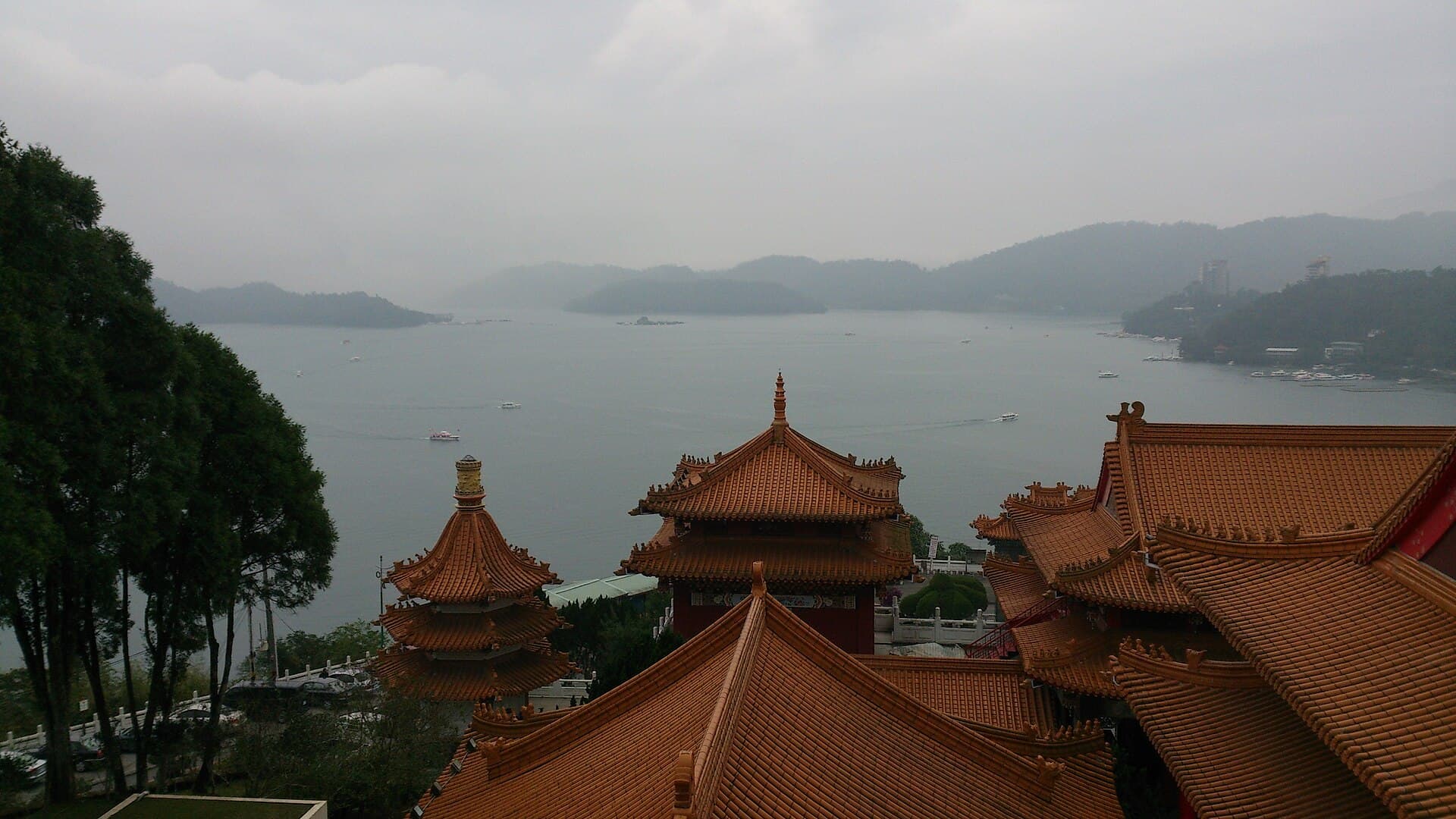
Wenwu Temple
During the Japanese colonial period, there were originally two temples by Sun Moon Lake: Longfeng Temple in Shuishe Village and Yihua Hall, originally in Bujicun (now Yuezhuang). Later, due to the construction of a power…
Visitor Essentials
24小時全日開放,20:00後,請由側門進入
During the Japanese colonial period, there were originally two temples by Sun Moon Lake: Longfeng Temple in Shuishe Village and Yihua Hall, originally in Bujicun (now Yuezhuang). Later, due to the construction of a power generation project by the Japanese, the water level of Sun Moon Lake rose, and both temples had to be relocated. The power company acquired the assets of the temples, which then used the proceeds to choose a new site and merge into one temple. The temple was rebuilt on Songbolun, north of Sun Moon Lake in 1934, and the relocation was completed in 1938. In 1969, Wenwu Temple was rebuilt again in the style of Chinese Northern Dynasties architecture, grand in scale and majestic in appearance. The temple is divided into three main halls: the second floor of the front hall, Shuiyun Temple, is dedicated to the founding ancestors and Wenchang Dijun (God of Culture and Literature); the central hall, Wusheng Temple, is dedicated to Guan Sheng Dijun (God of War) and Yue Wu Mu Wang (Yue Fei); and the rear hall, Dacheng Hall, is dedicated to Confucius, the Great Sage and Teacher, among others. Gods from Confucianism, Buddhism, and Taoism all reside together. Dacheng Hall of Wenwu Temple is the only Confucius Temple in Taiwan with a central gate. According to the temple, this is because Wenwu Temple is located by Sun Moon Lake, attracting many visitors, and the central gate was added for their convenience, not for any special symbolic meaning. However, the bronze seated statue of Confucius in Dacheng Hall makes it the only Confucius Temple in Taiwan housing a sacred statue. Besides Confucius, there are also statues of Mencius and Zisi. These three statues were originally enshrined in China and eventually made their way to Sayama Fudo-ji Temple in Japan during the Boxer Rebellion in the late Qing Dynasty. They were later replicated and moved to Wenwu Temple. As for the statues of Yan Hui and Zeng Shen, they were sculpted with funds raised by their descendants to accompany Confucius. The two giant vermilion stone lions on either side of the temple's front plaza are also a focal point for visitors. That pair of stone lions was donated by Wu Ho-Su, the founder of Shin Kong Group, which is why local residents affectionately refer to them as 'Wu Ho-Su' (a playful pun on his name and the word for lion, "shī"). Wenwu Temple is backed by mountains and faces the lake, boasting a magnificent location and beautiful scenery. It serves as a vibrant spiritual center for local residents. Climbing to the observation deck of the rear hall, one can gaze upon Sun Moon Lake, enjoying a vast panoramic view that evokes a sense of embracing the world with grandeur.
Discover the Context
No stories linked yet.
Happening at Wenwu Temple
View CalendarNo upcoming events at this venue.