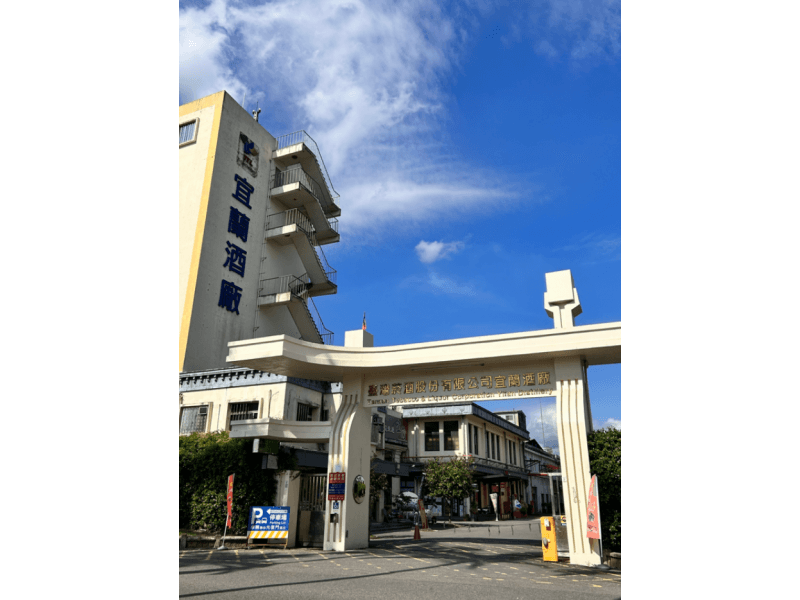
Yilan: Taiwan Tobacco and Liquor Corporation (TTL) Yilan Distillery Tourist Factory
【Assessment Validity Period: 2023/08/02~2026/08/01】 The Yilan Distillery was established in 1909 (2 years before the ROC calendar). Its predecessor was the privately-owned Yilan Wine-making Company. In 1920, it was reorg…
Visitor Essentials
平日:08:30-17:00,假日:08:30-17:30, (暑假旺季(7-9月)平日及例假日皆延長營業至17:30,除夕除外,全年無休)
【Assessment Validity Period: 2023/08/02~2026/08/01】 The Yilan Distillery was established in 1909 (2 years before the ROC calendar). Its predecessor was the privately-owned Yilan Wine-making Company. In 1920, it was reorganized as Yilan Brewing Co., Ltd. In 1922, the Japanese government implemented a liquor monopoly system, and it was subsequently transferred to be directly operated by the Yilan Branch Office of the Taiwan Governor-General's Office Monopoly Bureau. In 1945, it was taken over by the Nationalist Government. In 1957, it was named "Taiwan Provincial Tobacco and Wine Monopoly Bureau Yilan Distillery." In 2002, it was reorganized into its current form, "Taiwan Tobacco and Liquor Corporation Yilan Distillery," making it the oldest distillery in Taiwan with a history of over a century. The distillery complex includes 5 major historical buildings: 1. Administration Building: Completed in 1929 (Showa Year 4), this brick building is the administrative center of the distillery. In its early days, it was the "Yilan Branch Office of the Taiwan Governor-General's Office Monopoly Bureau." The building itself exhibits a beautiful Western Baroque style with elegant and exquisite design. The pillars on either side of the main entrance originally featured the "four-leaf motif" common during the Japanese colonial period, which was changed to a five-petal plum blossom after the Retrocession of Taiwan. 2. Kapsulan Wine Museum: The main building was completed in 1935 and is a distinctive steel-frame structure. Its original purpose was a raw material warehouse, with glutinous rice stored on the first floor and red yeast rice on the second. In 1998, the distillery opened for tourism and the building was renovated into a wine museum, named "Kapsulan" after Yilan's old place name. The second floor serves as a wine cultural exhibition area, showcasing the production process of Hong Lu wine and displaying related company products. The museum also offers an aroma sniffing area, "Lih-a-kah" (handcart), and bottle bundling techniques, aiming to convey knowledge of wine culture through sensory experiences like smell and sight. 3. Taiwan Red Yeast Rice Museum: The main building, constructed in 1927, was originally the Hong Lu wine blending room. Before each batch of wine leaves the distillery, its quality, flavor, mouthfeel, alcohol content, etc., must be controlled to ensure consistency; the blending room was where this control happened. In 2007, the blending room was relocated to the wine storage area, and the vacant space was converted into the Red Yeast Rice Museum. Centered around red yeast fungi, it uses the original vats as display installations, with some vats and spaces also serving as a creative cultural product sales center. The specially shaped "waist tower" on the roof was an addition to enhance ventilation, preventing the accumulation of wine fumes. 4. Hong Lu Gallery: Originally built in 1909 by Mr. Lin Ching-yun, the founder of the distillery. In 1922, the Japanese Governor-General's Office implemented a liquor monopoly in Taiwan, and the distillery was consequently requisitioned and underwent a complete factory reconstruction. This building was completed on its original site in 1926. Initially, it served as a wine production facility, later renovated to become a venue for employee meetings, training, cultural activities, recreation, and dining. In 2011, it was again renovated and transformed into the Hong Lu Gallery, serving as an exhibition platform for artists' works, thereby enriching the distillery's artistic atmosphere and cultural depth. 5. Container Warehouse: Constructed in 1942, it was soon damaged due to war. Afterwards, the distillery's original office (Administration Building) was loaned to the Yilan Branch of the Monopoly Bureau. The distillery then rebuilt this warehouse on its current site, restoring its original appearance, to serve as a temporary office. Several years later, the distillery's office moved back to the Administration Building, and this site was converted into a packaging material warehouse. The specially angled wooden pillars on the walls, known as "flying buttresses," were added because the original wooden warehouse roof was too heavy, and the beams and columns might not have been able to support it. It was replaced with two sets of connected smaller roofs, and wooden flying buttresses were added to the outer walls on both sides to bear the roof's weight, thus creating a unique landscape of slanted pillars protruding from the walls. Hong Lu wine originates from the "Old Red Wine" of Anxi County, Fujian Province, China. It is a fermented wine that, after a period of aging in urns, matures from an initial red liquid into a (clear, bright) amber color. Aged Hong Lu wine can be classified by age: 2-year Special Grade Hong Lu Wine, 3-year Golden Rooster Aged Hong Lu Wine, 6-year Cellar Aged Golden Rooster Old Red Wine, and 12-year Cellar Aged Golden Rooster Old Red Wine featuring designs of the Eight Sceneries of Lanyang. The wine is mellow and smooth, and it is also a distinctive souvenir from Yilan. The Yilan Distillery is the company's only distillery that uses red yeast rice fermentation techniques to produce traditional Hong Lu wine products with local characteristics. In 2006 (ROC Year 95), through a public vote by Yilan County residents and official government documents, Hong Lu wine was officially designated as "Yilan County Wine." Within the distillery complex, characteristic products like Hong Lu wine and Old Red Wine are crafted into large-scale art installations for visitors to check in and take photos. There is also a "plastic crate influencer wall" that is very popular with the public. Strolling through the complex, visitors can discover knowledge about red yeast rice and the early Taiwanese production process of Hong Lu wine everywhere. The Taiwan Red Yeast Rice Museum provides much information and knowledge related to red yeast rice, while the Kapsulan Wine Museum creates a "Taiwan Hong Lu Wine Aroma" ambiance. To meet public demand, free guided tours and paid DIY activities (NT$200 per person) are offered, hoping to awaken public awareness of the traditional value of "Hong Lu Wine Culture" and "Red Yeast Rice Culture." In the future, the company will continue to grow with everyone, upholding the philosophy of culture, service, and quality. ♦ Excessive drinking is harmful to health ♦ ♦ Don't drink and drive; don't drive after drinking ♦ ♦ No drinking for those under 18 ♦
Discover the Context
No stories linked yet.
Happening at Yilan: Taiwan Tobacco and Liquor Corporation (TTL) Yilan Distillery Tourist Factory
View CalendarNo upcoming events at this venue.