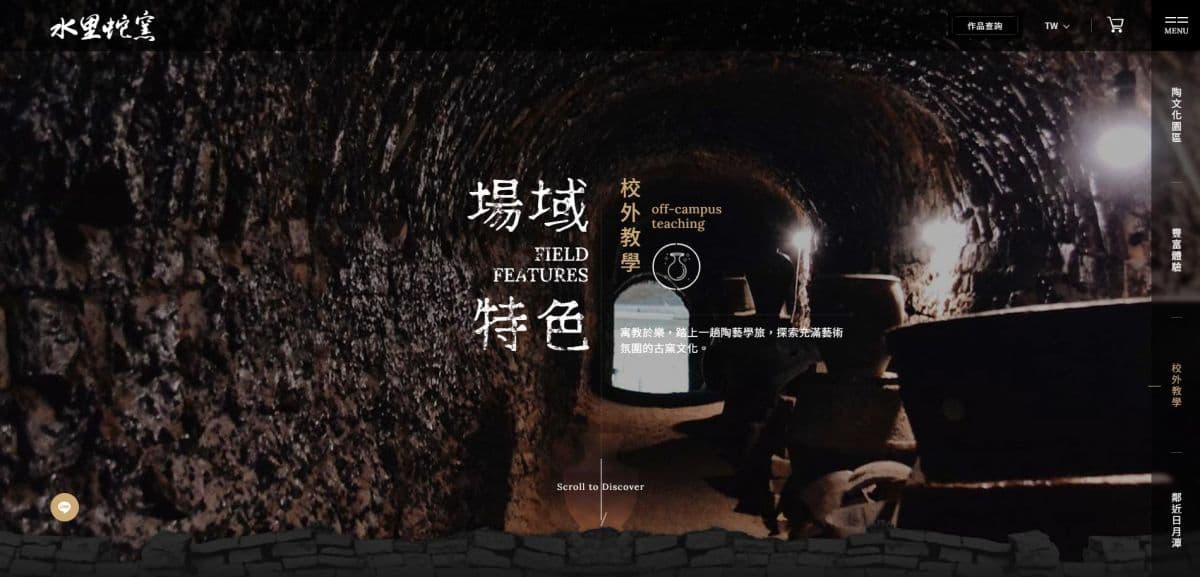
Nantou: Shuili Snake Kiln Ceramics Cultural Park
[Evaluation Validity Period: 2023/06/27~2026/06/28] The "snake kiln" originated in Fuzhou, mainland China. This type of kiln is built with earth bricks along a mountain slope, and its body is very long, resembling a snak…
Visitor Essentials
全票:$150 優惠票:$120(7歲以上學生/65歲以上長輩) 愛心票:$100(持有身障手冊本人及陪同一人/4-6歲幼童) 免費(3歲以下幼兒/水里鄉民憑證) **團體票(30人以上) 全票:$120 優惠票:$100(7歲以上學生/65歲以上長輩) 愛心票:$80(持有身障手冊本人及陪同一人/4-6歲幼童)
[Evaluation Validity Period: 2023/06/27~2026/06/28] The "snake kiln" originated in Fuzhou, mainland China. This type of kiln is built with earth bricks along a mountain slope, and its body is very long, resembling a snake from a distance, hence its name. Towards the end of the Ming Dynasty, Koxinga (Zheng Chenggong) led troops to Taiwan for the "resist Qing, restore Ming" movement, but ultimately failed. He then disbanded his soldiers, some of whom were familiar with this kiln technology and settled here, marking the beginning of snake kilns in Taiwan. The Shuili Snake Kiln dates back to 1927 (the 16th year of the Republic). Mr. Lin Jiang-Song, a master potter from Nantou, recognized that the Shuili area was then a timber distribution center, rich in fuel and possessing high-quality clay, making it ideal for pottery production. Thus, he moved his entire family here, built a snake kiln, and has been producing pottery ever since. The snake kiln has a spacious interior, allowing for the firing of larger pottery pieces, and was initially famous worldwide for producing large ceramic water vats. In 1943 (the 32nd year of the Republic), prior to Japan's attack on Pearl Harbor, this factory was ordered to produce military "air-raid shelter jars." Consequently, workers at this factory were exempted from conscription to serve as soldiers overseas, highlighting the importance of the Shuili Snake Kiln at that time. After many years of refinement, the Shuili Snake Kiln has not only gone through the proud era of "Shuili ceramic vats" but also experienced the bitter years of decline. Currently, under the ingenious planning of the third-generation owner, Mr. Lin Guo-Long, it has been repackaged as the "Shuili Snake Kiln Ceramics Cultural Park," serving both recreational and cultural education functions. It preserves Taiwan's oldest and most traditionally representative historical wood-fired kiln, fully presenting the authentic life of a kiln site. At the same time, to allow the public to further understand snake kiln culture and make the snake kiln a living local textbook, the park features: a multimedia presentation room, a historical museum, pottery classrooms, and more. Professional guides and resident masters are arranged to conduct park tours and pottery lessons, and the scale of the old factory is maintained to continue producing products with strong local characteristics. It is hoped that through this planned transformation, the snake kiln will offer a rustic, intellectual, and aesthetic beauty, passed down through generations and continuously thriving.
Discover the Context
No stories linked yet.
Happening at Nantou: Shuili Snake Kiln Ceramics Cultural Park
View CalendarNo upcoming events at this venue.