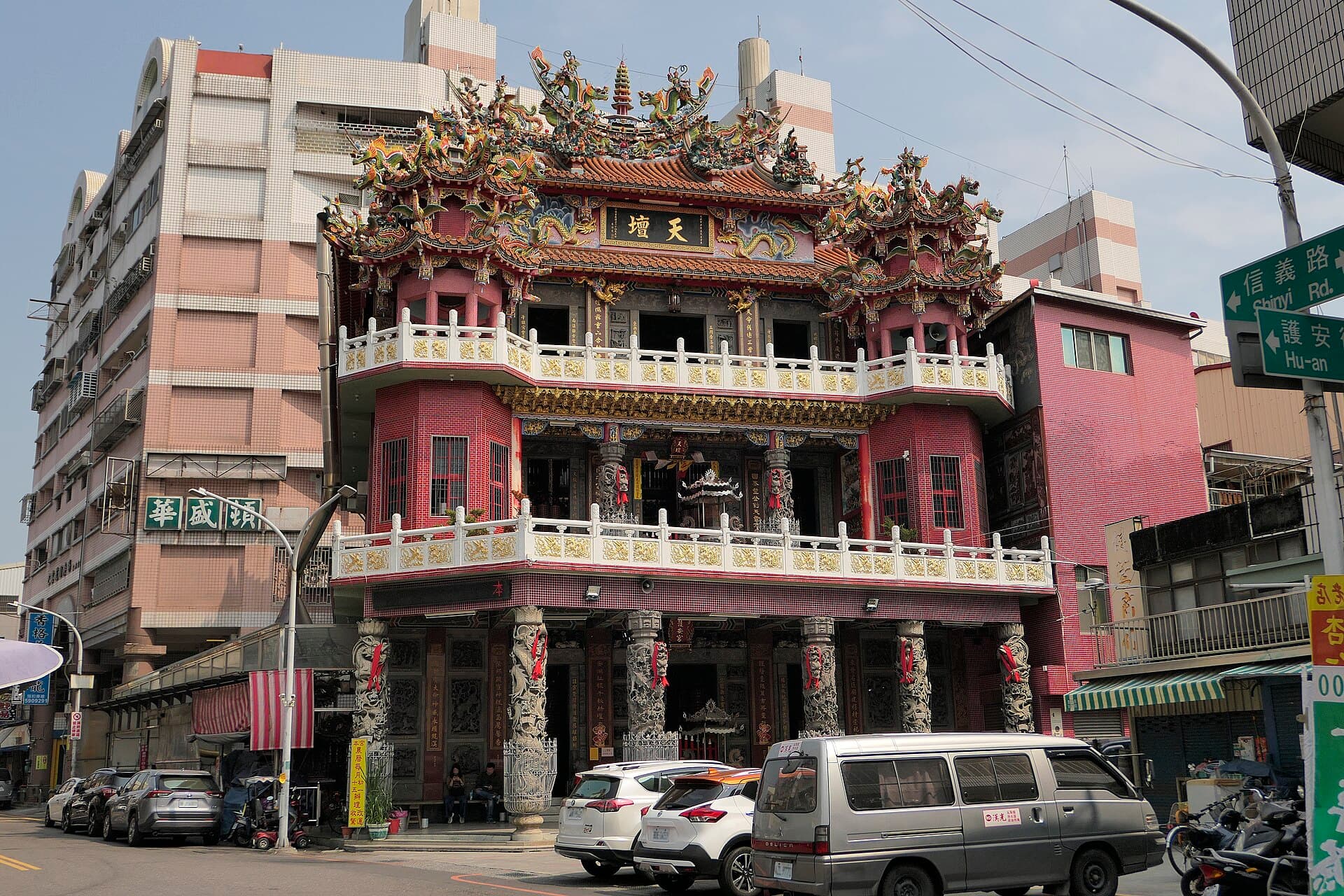
Tiāntán Hù'ān Temple
The original name was 'Hù'ān Temple' (formerly known as 'Wánggōng Temple' or 'Wánggōng Hall'). It is primarily dedicated to the Protector King (Hùguó Zūnwáng), who was a prime minister during the reign of Emperor Xiaowu…
Visitor Essentials
The original name was 'Hù'ān Temple' (formerly known as 'Wánggōng Temple' or 'Wánggōng Hall'). It is primarily dedicated to the Protector King (Hùguó Zūnwáng), who was a prime minister during the reign of Emperor Xiaowu of the Eastern Jin Dynasty. He was later promoted to Grand Protector and Grand Tutor, with the surname Xie, given name An, courtesy name Anshi, and alias Dongshan. Also enshrined is Marshal Xie (Xièfǔ Yuánshuài), a General of Chariots and Cavalry during the Eastern Jin Dynasty, and the son of Xie Yi (elder brother of Marshal Xie An). He was granted the vanguard flag by imperial decree, with the surname Xie and given name Xuan. Both were great heroes of the Battle of Fei River. The Protector King was brought to Taiwan by a general named Xie, a subordinate of Koxinga (Zheng Chenggong), Prince of Yanping, from Longxi County, Zhangzhou Prefecture, Fujian, during Koxinga's arrival in Taiwan at the end of the Ming Dynasty. He was enshrined behind the Xinhua military camp and worshipped in rotation at the homes of the incense masters. Due to a lack of documented records and incomplete steles, only a general outline is known through the recollections and narratives of ancestors. According to records in the Xinhuazhen Gazette, in the 12th year of Jiaqing (1807 AD), the 'Continued Revision of Taiwan County Gazette' was jointly compiled by Instructor Xie Jinluan of Jiayi County School and Instructor Zheng Bingcai of Taiwan County School. Taiwan County Magistrate Xue Zhiliang oversaw the political gazette. The second volume, in the section on altars and temples, recorded: 'Xie Dongshan Temple is located in Damujiang Village (dedicated to Xie An of the Jin Dynasty, commonly known as Wanggong Temple. Its original construction date, like that of Zhang Suiyang Temple, is unknown. In the 29th year of Qianlong [1764], villagers Yao Xingbang and others initiated repairs, and in the 59th year [1794], Chen Guangmiao and others undertook further repairs).' What was recorded in the county gazette at that time, as well as what ancestors commonly referred to as Wanggong Hall and Guanyin Hall, were both flourishing side-by-side in the lower fort of Damujiang Street, the earliest prosperous area during the early Qing Dynasty. From this, it can be concluded that Wanggong Temple (Hù'ān Temple) was indeed an ancient temple founded during the Kangxi era, which is clearly evident. It was in the 6th year of Daoguang (1826 AD), the Bǐngwǔ year, that the temple was first established and consecrated at its current site; this was its initial grand construction, not a new establishment.
Discover the Context
No stories linked yet.
Happening at Tiāntán Hù'ān Temple
View CalendarNo upcoming events at this venue.