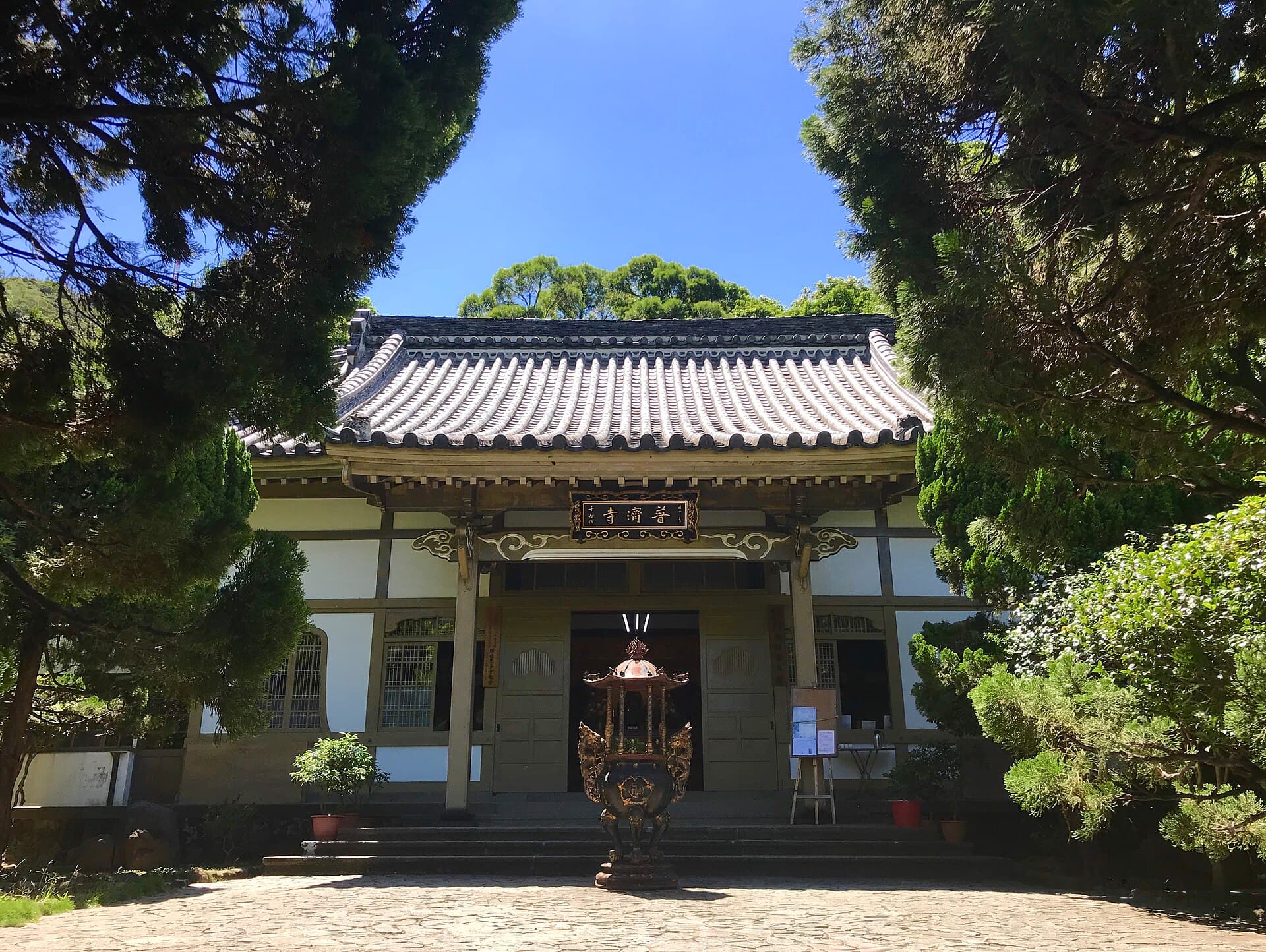
Beitou Puji Temple
According to "Taiwan Buddhist Monuments and Treasures," published by Taipei's "Mindu Photo Studio" in 1941, Puji Temple, along with Linji Huguo Chan Temple (also a designated municipal historic site in Taipei), served as…
Visitor Essentials
According to "Taiwan Buddhist Monuments and Treasures," published by Taipei's "Mindu Photo Studio" in 1941, Puji Temple, along with Linji Huguo Chan Temple (also a designated municipal historic site in Taipei), served as a missionary base in Taipei for the Myoshin-ji branch of the Rinzai school. When it was rebuilt in 1934, because many of its devotees were employees of the Railway Department of the Taiwan Governor-General's Office, it was named "Tesshin-in" (鐵真院) after Tetsushin (鐵真), the posthumous name of Murakami Shoichi (村上彰一), the chief of the Railway Department's Transport Section. A monument to "Elder Murakami Shoichi" was also erected in the temple. It was officially designated a municipal historic site in 1998, and its environment exudes a tranquil and serene atmosphere. The temple exhibits a distinct Japanese style. The main hall's architecture features a single-eave hipped-gable roof with a three-bay width and three-bay depth, creating a nearly square shape. The roof extends forward to form an entrance porch. Inside the main hall, the elevated floor is covered with tatami mats, showcasing the simple, serene, yet solemn beauty of a Japanese ancestral temple. The main hall itself is constructed from high-grade cypress wood. To this day, the temple retains Japanese worship rituals, distinct from traditional Taiwanese worship customs. The bell-shaped windows beside the main entrance are a unique feature. In the entrance porch, one can admire exquisitely carved dougong (bracket sets) and rainbow beams. The plaque inscribed with "Puji Temple" was personally calligraphed by Yu You-ren. It is worth mentioning that in the pavilion to the left of the temple, a stone Buddha statue is enshrined, depicting a figure holding an infant in its left arm and a Zen staff in its right. The general public refers to this statue as 'Guanyin, the Giver of Children,' while Buddhist scholars identify it as the Japanese 'Koyasu Kannon' (Child-Giving Bodhisattva), one of the manifestations of Ksitigarbha Bodhisattva. This statue attracts many devout men and women who come to pray for offspring. These two deities, Tangshou Guanyin and Koyasu Kannon, have become a major highlight of the temple.
Discover the Context
No stories linked yet.
Happening at Beitou Puji Temple
View CalendarNo upcoming events at this venue.