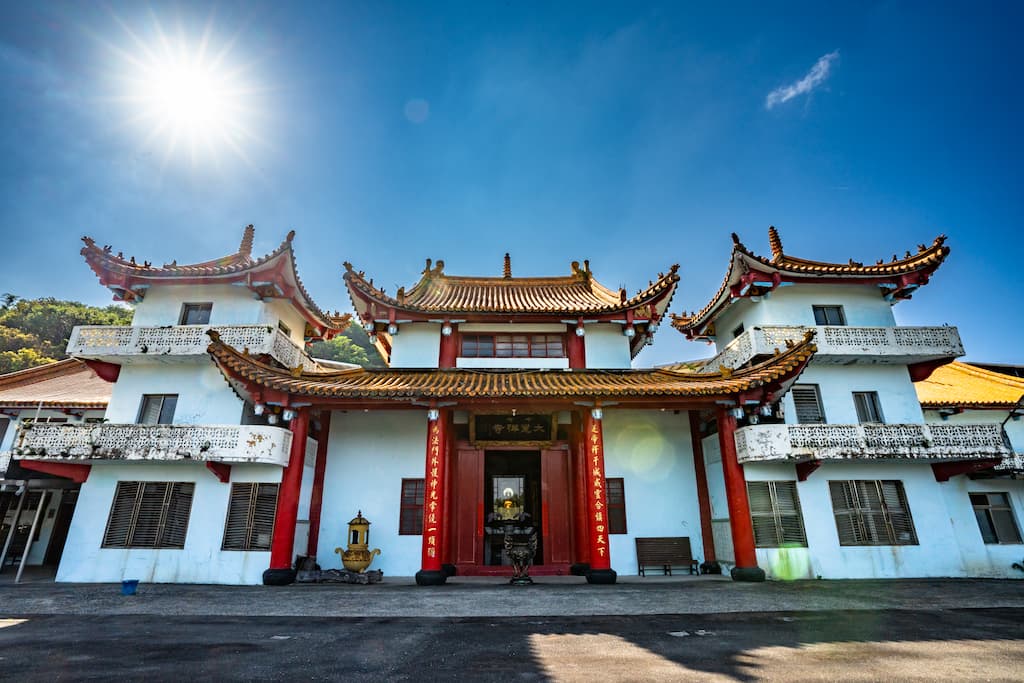
Shifang Dajue Temple
Shifang Dajue Temple is situated on the hilltop of Chongde Road in Anle District, occupying a vast area with an expansive view that allows for distant vistas of Keelung Port. Built against the mountain, Shifang Dajue Tem…
Visitor Essentials
09:00~17:00
Shifang Dajue Temple is situated on the hilltop of Chongde Road in Anle District, occupying a vast area with an expansive view that allows for distant vistas of Keelung Port. Built against the mountain, Shifang Dajue Temple boasts a magnificent and majestic presence. It retains the layout of an ancient Chinese-style garden, creating an elegant and serene environment rarely seen in a bustling modern metropolis, making it even more distinctive. Surrounding the central courtyard of Shifang Dajue Temple are numerous halls, most notably the four awe-inspiring statues of the Heavenly Kings within the Hall of Heavenly Kings, whose tall and mighty figures command admiration and reverence. In the rear courtyard stands the Mahavira Hall, and by following a path further, one can reach a Guanyin Pavilion on the back mountain, where the Thousand-Handed and Thousand-Eyed Guanyin is enshrined, appearing solemn yet benevolent, making it a profoundly tranquil and solemn Buddhist sanctuary. Additionally, other temple structures such as the Sutra Repository and the Hall of Five Contemplations contribute to an overall atmosphere of solemnity and peace, making visitors feel as if they are in a Buddhist Pure Land, bringing a deep sense of inner calm and spiritual cleansing. The Patriarch Hall at the back enshrines the sarira (relics) of the Venerable Master Xuyun, and adjacent to it stands a seven-story pagoda, offering a panoramic view of the entire cityscape, much like a lighthouse. According to records, in the 43rd year of the Republic of China (1954), the itinerant monk Master Weiding vowed to build a temple on the hilltop of Lane 10, Chongde Road, Yongkang Village, and invited the renowned Master Lingyuan from Zhejiang to preside over it. At that time, most sailors from Zhejiang resided in Keelung, and the treacherous sea conditions led them to devoutly pray to Buddha. They never failed to visit this temple to offer prayers before setting sail or returning to port. Consequently, Dajue Temple's incense offerings began to flourish, and donations gradually increased, enabling its rapid and large-scale expansion. Subsequently, in the 48th year of the Republic of China (1959), construction commenced on the seven-story Anle Pagoda. The entire temple complex was arranged with the Mahavira Hall centrally located, followed by the Ksitigarbha Hall to its rear, the Great Compassion Hall to its left, and the Dajue Buddha Hall and Sutra Lecture Hall in front. The Hall of Heavenly Kings featured both upper and lower levels, forming a substantial and comprehensive layout. Shifang Dajue Temple stands as a significant cornerstone for the establishment of Chan Buddhism in Taiwan. Its solemn and ancient appearance, the far-reaching and reverent sounds of its morning bell and evening drum, combined with the scenic landscape of Keelung Port, have earned the 'Great Enlightenment Buddhist Chant' (Dajue Fanyin) a place among the Eight Scenic Spots of Keelung.
Discover the Context
No stories linked yet.
Happening at Shifang Dajue Temple
View CalendarNo upcoming events at this venue.