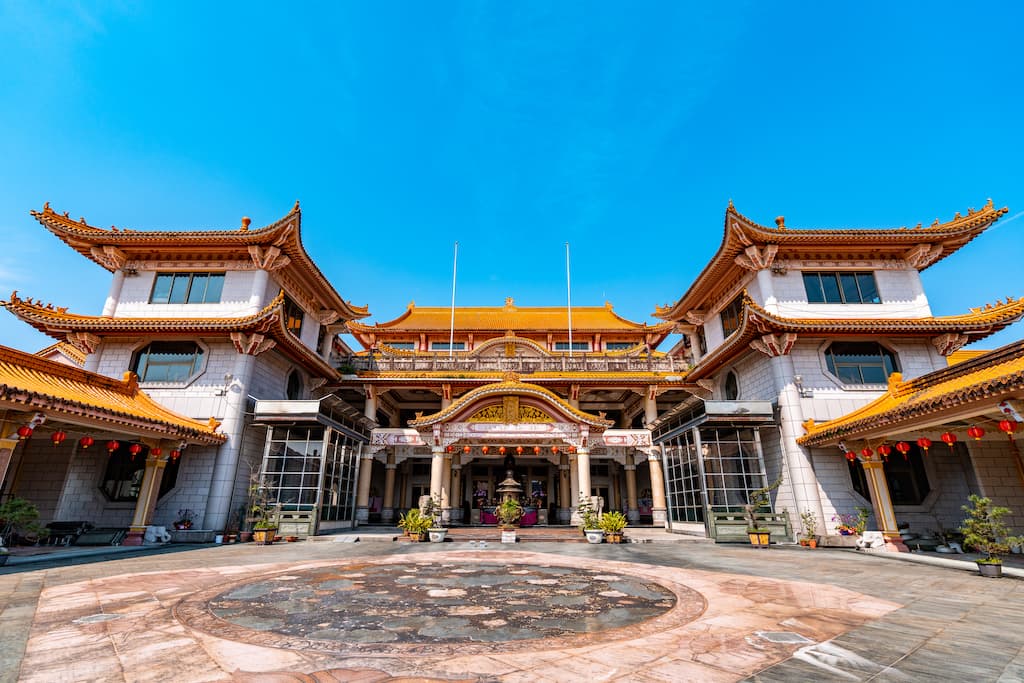
Lingquan Zen Temple on Yuemei Mountain
Just as its name suggests, the secluded Lingquan Zen Temple stands on the mountainside of Yuemei Mountain, surrounded by mountains and lush greenery, creating a "Zen realm" that helps quiet the mind. Founded in 1898 (Mei…
Visitor Essentials
09:00~17:00
Just as its name suggests, the secluded Lingquan Zen Temple stands on the mountainside of Yuemei Mountain, surrounded by mountains and lush greenery, creating a "Zen realm" that helps quiet the mind. Founded in 1898 (Meiji 31 during the Japanese colonial period), it has a history of over a hundred years and is a well-known Buddhist temple in Taiwan. Lingquan Zen Temple is Taiwan's first Zen monastery of a "jungle" scale (referring to a large, comprehensive monastic complex), and the birthplace of Buddhist temples in northern Taiwan, earning it the name "First Monastery of Northern Taiwan." A century ago, eminent monks Shanzhi and Miaomi from Yongquan Temple on Gushan Mountain in Fujian came to Taiwan and propagated Buddhism at Dianji Temple. As the number of converts grew, they decided to build a new temple. Later, devotee Lin Laifa donated one 'jia' (a unit of land area) of sloped vegetable garden land, and construction began the following year. After the two pioneering Zen masters passed away, Lingquan Zen Temple completed the Buddha Hall, Kaishan Hall (Founding Patriarch Hall), Zen Hall, and other projects under the leadership of Master Shanhui. The temple primarily features a quadrangle-style architecture, a simple ancient monastery constructed from bricks, tiles, wood, and stone. After several renovations, the new mountain gate is quite majestic, and even the Mahavira Hall is grand and imposing. In the temple's front hall, Maitreya Bodhisattva is enshrined in the center, flanked by the Four Heavenly Kings (Vajra Guardians); the rear hall is the main hall, housing the principal deity, Sakyamuni Buddha. To the right of the main hall is the Sarira Hall, housing a reclining jade Buddha. To the left is the Ancestral Hall, where ancestral incense tablets are placed in the center. Among the sacred statues in the temple, such as the Dharma Protector Zhutian, enshrined Buddhas and Bodhisattvas, and the Sixteen Arhats, all were sculpted by the renowned Fujian craftsman Lin Qifeng. His works often display remarkable likeness, whether in the form of the ushnisha (protuberance on Buddha's head), the divine expression of the face, the treatment of drapery, or the placement of pigment lines. At Lingquan Zen Temple, you can ascend to enjoy distant views or stroll along ancient paths, experiencing the serene tranquility of this Buddhist sanctuary. Besides the temple itself, there are also the Kaishan Hall (Founding Patriarch Hall) and Lingquan Three Pagodas, both listed as historical monuments. The Kaishan Hall's architectural exterior combines Chinese and Western styles, with a touch of Southeast Asian flair. It is a shrine belonging to Lingquan Zen Temple that differs from traditional Taiwanese temple architecture, completed around 1920, making it the earliest building constructed within the temple complex. The "Lingquan Three Pagodas," also located on Liuhe Road, are modeled after Indian stupas, a rare sight nationwide. Their ancient and charming architectural appearance creates a unique ambiance, not only embodying the Buddhist spirit but also showcasing a rich Buddhist artistic atmosphere, making visitors linger in the elegant and tranquil environment.
Discover the Context
No stories linked yet.
Happening at Lingquan Zen Temple on Yuemei Mountain
View CalendarNo upcoming events at this venue.