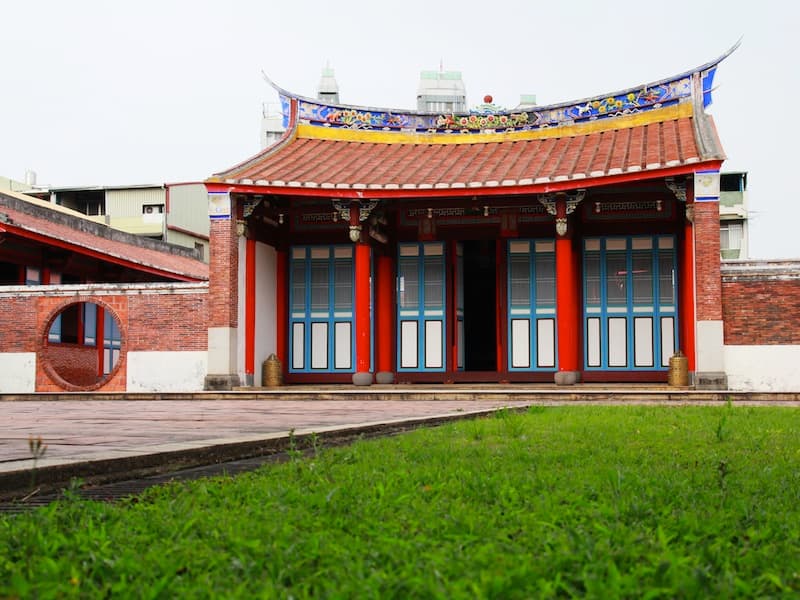
Pingtung Academy
Pingtung Academy, also known as the Confucius Temple, was initiated in 1814 (the 19th year of Jiaqing, Qing Dynasty) by Wu Xingcheng, the county magistrate of Xiadanshui, together with provincial tribute students Guo Cui…
Visitor Essentials
屏東書院-週二至週日(含國定假日)早上八點至下午五點半,免費入園參觀。園區K書中心-週二至週日(含國定假日)早上八點至晚上九點
Pingtung Academy, also known as the Confucius Temple, was initiated in 1814 (the 19th year of Jiaqing, Qing Dynasty) by Wu Xingcheng, the county magistrate of Xiadanshui, together with provincial tribute students Guo Cui and Lin Mengyang, among others, to revitalize local cultural and educational development. Despite undergoing multiple relocations and renovations, the academy has retained its original layout of a lecture hall, worship hall, and student dormitories, fully showcasing the unique spatial characteristics of a traditional academy. It is a historical monument with a long history in Pingtung and the only academy building within the Pingtung area. Pingtung Academy was originally built within today's Zhongshan Park, featuring 36 student dormitories. The front hall served as a lecture hall, and the rear hall was dedicated to the worship of Wenchang Dijun (God of Culture and Literature), Cheng Zi, and Zhou Zi. In 1895 (the 21st year of Guangxu), Pingtung Academy was converted into a Confucius Temple. Confucius became the principal deity, accompanied by the Four Sages—Mencius, Yan Hui, Zisi, and Zeng Shen—and the Five Great Scholars—Zhou Dunyi, Zhu Xi, Cheng Yi, Cheng Hao, and Zhang Zai. However, due to a lack of funds for repairs, the Confucius Temple gradually fell into disrepair. In 1937, the Japanese rulers of Taiwan planned to relocate the Confucius Temple elsewhere. However, following urgent calls for preservation from Japanese scholars, it was meticulously dismantled and reassembled at its current site on Shengli Road, retaining its original academy appearance. Nevertheless, for a long period after its relocation, the Confucius Temple again fell into a dilapidated state due to a lack of active maintenance. It wasn't until 1977 (the 66th year of the Republic of China) that the then Pingtung County Magistrate invited renowned architect Mr. Han Pao-teh to oversee a restoration project. By 1979 (the 68th year of the Republic of China), the Confucius Temple was finally restored to its former glory. After the renovation, the Confucius Temple's courtyard area was expanded, and the front and rear halls were connected by covered walkways and pavilions. The central hall was renamed "Dacheng Hall" (Hall of Great Completion), and the rear hall became "Chongsheng Shrine" (Shrine for Worshiping Sages). A single-sloped covered walkway was added, along with a spirit screen inscribed with "Nine Ren Gong Qiang" (a metaphor for the profundity of Confucius's teachings). Additionally, four steles were preserved to document the academy's construction history. In 1985 (the 74th year of the Republic of China), Pingtung Academy was designated as a National Third-Class Historic Site, a well-preserved historical monument with significant cultural value.
Discover the Context
No stories linked yet.
Happening at Pingtung Academy
View CalendarNo upcoming events at this venue.