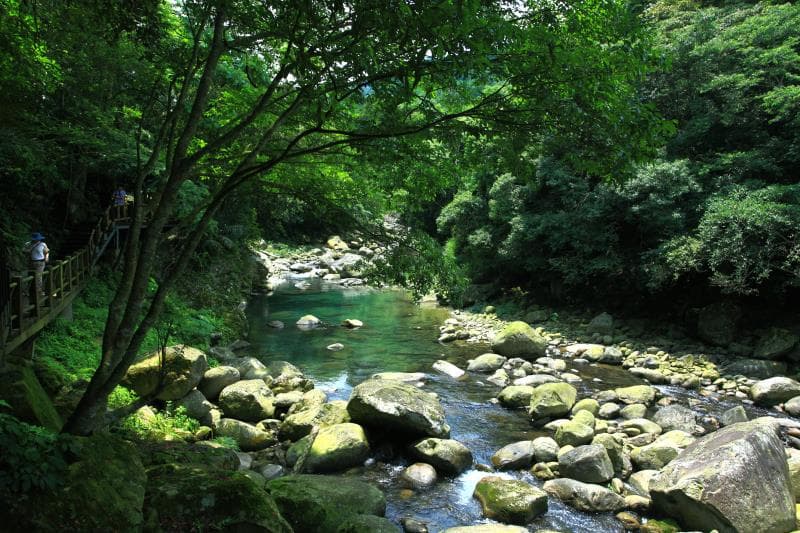
Penglai Stream Fish Conservation Trail
Penglai Stream is located in the southwest of Nanzhuang and is an upstream tributary of the Zhonggang Stream. Due to its secluded location deep in the mountains, the stream is flanked by steep peaks. The surrounding area…
Visitor Essentials
每日開放
Penglai Stream is located in the southwest of Nanzhuang and is an upstream tributary of the Zhonggang Stream. Due to its secluded location deep in the mountains, the stream is flanked by steep peaks. The surrounding area is a mix of bamboo groves and natural mixed forests, lush and towering, where mountains and rivers intertwine. Being there, one can sometimes hear the forest conversing with the mountain breeze, and sometimes hear the stream water singing with the fish. The naturally formed scenery makes one involuntarily cast aside all stress; troubled minds settle, and noisy sounds disappear. Here, one only wants to take deep, deep, deep breaths, touch the cool stream water, observe the graceful figures of Formosan Shovelnose Minnows (苦花), walk through the forest, cross the stream, and then return home filled with phytoncides and renewed energy. Looking at the clear stream water before you, with fish swimming in schools, you might not believe that fish once disappeared from here. The beautiful appearance it has today is the result of the diligent efforts of Nanzhuang Township residents. Initially, a group of local residents who loved their hometown, feeling that the stream's ecosystem was being destroyed, spontaneously formed the “Penglai Stream Neighborhood Watch Fish Conservation Patrol Team.” They patrolled the stream, reminding and advising visitors active in the stream to reduce pressure on the stream's ecosystem, hoping to restore the stream to its original state. Miaoli County Government also announced in 2001 that fishing would be banned in the middle and upper reaches of Penglai Stream in Nanzhuang Township to protect fish, completely prohibiting any fishing or angling activities within the protected sections of the stream. It was the first stream in Miaoli County to implement fish conservation measures. Thanks to the active efforts of the residents, fish conservation in Penglai Village has been successful. In 2002, it even received the “Excellent Natural Landscape Award” as part of the “Charming Towns and Cities Award” from the Ministry of Interior. Today, the stream water is crystal clear, and from the bank, one can see schools of fish swimming gracefully in the water. Formosan Shovelnose Minnows (苦花) and Formosan Rockfish (石賓) flash silver in the water, a beautiful and moving sight. Occasionally, one can even witness fish leaping upstream over rocks. The middle and upper reaches of Penglai Stream have implemented a fishing ban for fish conservation, completely prohibiting any fishing or angling activities within the protected sections of the stream. It was the first stream in Miaoli County to implement fish conservation measures. Thanks to the active efforts of the residents, fish conservation in Penglai Village has been successful. In 2002, it even received the “Excellent Natural Landscape Award” as part of the “Charming Towns and Cities Award” from the Ministry of Interior. Today, the stream water is crystal clear, and from the bank, one can see schools of fish swimming gracefully in the water. Formosan Shovelnose Minnows (苦花) and Formosan Rockfish (石賓) flash silver in the water, a beautiful and moving sight. Occasionally, one can even witness fish leaping upstream over rocks. The fish conservation trail is 2.4 kilometers long. If you walk quickly, a round trip takes about an hour and a half. However, since you're here to hike, exercise, and experience nature, we sincerely recommend slowing down, stopping frequently, and exploring the fish, insects, plants, and shy small animals hiding behind trees and under rocks that greet you along the way. The natural ecology is endlessly wondrous and full of surprises at every turn! Water Spirits of Penglai Stream: The Formosan Shovelnose Minnow, commonly known as “Bitterling” (苦花), has a mouth located relatively low. When it feeds on algae on rocks, it often bumps its head. Therefore, it evolved a survival mechanism to quickly disengage by flipping its body. When it flips, its silvery-white belly flashes in the water, earning it the nickname “firefly of the water.” The Taiwanese Minnow (台灣馬口魚) prefers cold waters, is a strong swimmer, and excels at leaping. It mostly inhabits the middle and upper reaches of rivers and their tributaries. It is omnivorous, leaning towards carnivorous, primarily feeding on aquatic insects. Its most distinctive feature is a slightly wide blue-black longitudinal band running along the center of its body from behind the gill cover to the end of the caudal peduncle. Adult fish can reach up to 20 centimeters in length. The Formosan Rockfish (台灣石賓) is endemic to Taiwan, found in the swift-flowing, clear waters and deep pools of the middle to upper-middle reaches of rivers. It feeds at night and is omnivorous. During its juvenile stage, its body has 7 black transverse bands; as it matures, its body darkens and the bands become less distinct. Plants Visible Along the Way: Acorus gramineus (石菖蒲) belongs to the Araceae family. It is a perennial evergreen herb that thrives in low-altitude stream environments. Its rhizomes creep, and its leaves are linear, about 30 cm long. Because of its slender, sword-like appearance, it is also known as “Water Sword Grass.” The entire plant has a unique fragrance and can be used medicinally. Since ancient times, Acorus gramineus has been beloved by literati and, along with orchids, chrysanthemums, and narcissus, is known as one of the “Four Gentlemen of Flowers and Plants.” Angel's Trumpet (大花曼陀羅) belongs to the Solanaceae family. It is an evergreen shrub with alternate leaves and solitary, drooping, trumpet-shaped white flowers. It blooms year-round, emitting a strong fragrance at night to attract nocturnal insects for pollination. The entire Angel's Trumpet plant is toxic, especially its flowers and seeds. People often mistake it for lilies and cook it, so extreme caution is advised. Taiwan Bird's Nest Fern (台灣巢蕨), also known as Taiwan Asplenium nidus, is found in low-altitude natural broadleaf forests in Taiwan. It often grows on tree trunks or rocks and is an indicator plant of subtropical broadleaf forests. Toddalia asiatica (飛龍掌血) is an evergreen climbing shrub belonging to the Rutaceae family. It has alternate, trifoliate leaves with oblong leaflets 4-6 cm long, found in low to mid-altitude secondary forests or coastal hills throughout the island. Be especially careful when encountering “Toddalia asiatica”! Its name, meaning “Flying Dragon's Bloody Claw,” comes from its formidable appearance: “thick vines with huge thorns, dense like scales” describes its body, and “new vines with dense thorns, appearing like three claws” refers to its grasping stems. One careless touch can draw blood, hence its name.
Discover the Context
No stories linked yet.
Happening at Penglai Stream Fish Conservation Trail
View CalendarNo upcoming events at this venue.