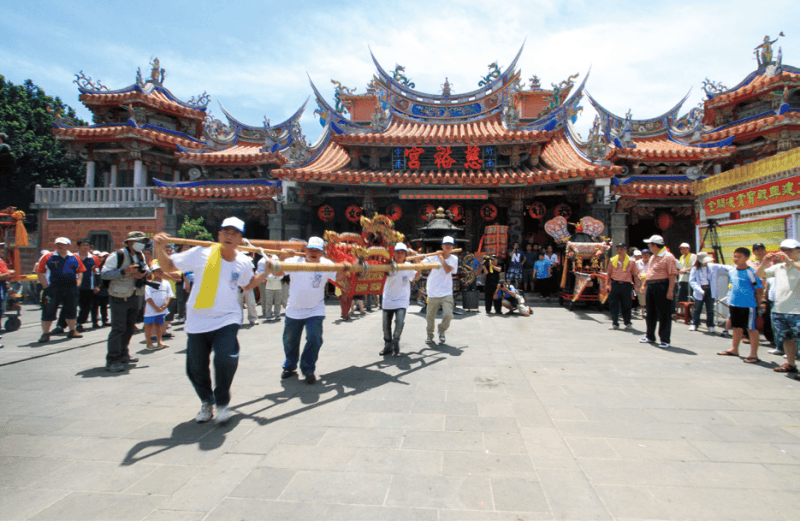
Zhonggang Ciyou Temple
Ciyou Temple is dedicated to Mazu, commonly known as Zhonggang Mazu. It is recognized as one of the "Three Great Mazu Temples of Taiwan" along with Beigang Chaotian Temple and Donggang Donglong Temple. The lantern festiv…
Visitor Essentials
每日開放
Ciyou Temple is dedicated to Mazu, commonly known as Zhonggang Mazu. It is recognized as one of the "Three Great Mazu Temples of Taiwan" along with Beigang Chaotian Temple and Donggang Donglong Temple. The lantern festival on the 15th day of the first lunar month, temple fairs on March 23rd and September 9th, and the "Jisi Lu Dian" (deer sacrifice ritual) during the Zhongyuan Festival (Ghost Festival) often bring rare lively scenes to Zhonggang. Stone carvings are the main decorative elements of Ciyou Temple, including the main entrance and exterior eaves decorations, verandas, and columns. The pair of bluestone lions at the central gate of the front hall are currently known as the temple's earliest excellent stone carvings. The coiled dragon stone pillars in the front hall are the only remaining pair of early dragon pillars at Ciyou Temple, characterized by their extremely slender carved cores. Aside from the "Bombing Handan" (Zha Handan) on the Lantern Festival, another distinctive folk activity at Ciyou Temple is the "Wash Port and River Sacrifice" (Xigang Jijiang). "Wash Port and River Sacrifice" is the only summer Mazu pilgrimage in the country. On Dragon Boat Festival day, Mazu leads four other deities on a procession around Zhonggang, performing various rituals at the estuary. After the rituals, everyone must turn their backs to the estuary and quietly leave without making any sound, while the statues of the deities must face the estuary as they retreat, symbolizing the purification of the land and the protection of everyone's safety. "Bombing Handan," held on the evening of the Lantern Festival, involves four sedan bearers, who are "bare-chested," "wearing money hats," "wearing shorts," "wearing cloth shoes," and "holding brooms," escorting a palanquin with the golden statue of the deity. Along the way, the palanquin stops at various points to receive cannon fire from devotees. Why is it called Zhonggang? Zhonggang is clearly in northern Taiwan, so why is it called "Middle" (Zhong) Port? Zhonggang was the earliest developed port city in Zhunan Township. In the past, when people from mainland China traveled to Taiwan by boat, they were not very familiar with Taiwan's complete geography. They believed Zhonggang was situated between Lugang and Keelung, hence it was named Zhonggang. "Bombing Handan" Mini-Profile: Currently, the "Bombing Handan" activity is still preserved in two locations in Taiwan: Taitung and Zhunan. In Zhunan, Miaoli County, four bare-chested sedan bearers carry the golden statue of Marshal Xuanta (God of Wealth) to receive a baptism of firecrackers; in Taitung, they carry a person possessed by Lord Xuan Tan. Bluestone Lions: The bluestone lions were donated by devotees in the 48th year of Emperor Qianlong's reign (1783). Their texture is fine, and they feel cool and somewhat moist to the touch in summer, which is extremely unique. They are one-of-a-kind bluestone artistic masterpieces in Taiwan. Ancient Sandalwood Incense Burner: Most incense burners used in temples are made of metal, porcelain, or stone. However, Ciyou Temple possesses a unique "ancient sandalwood incense burner," which is the only one of its kind in Taiwan and holds great artistic value. Jingjing Spring: Legend has it that Jingjing Spring was excavated when Liu Ming-chuan, the Governor of Taiwan, stationed his troops at Ciyou Temple. It was described as "a spring gushing with sweet, clear water, visible to the bottom, built into a hexagonal shape with stones, and named Jingjing Spring." Although it has now been replaced by tap water, it still represents the struggles and efforts of early settlers.
Discover the Context
No stories linked yet.
Happening at Zhonggang Ciyou Temple
View CalendarNo upcoming events at this venue.