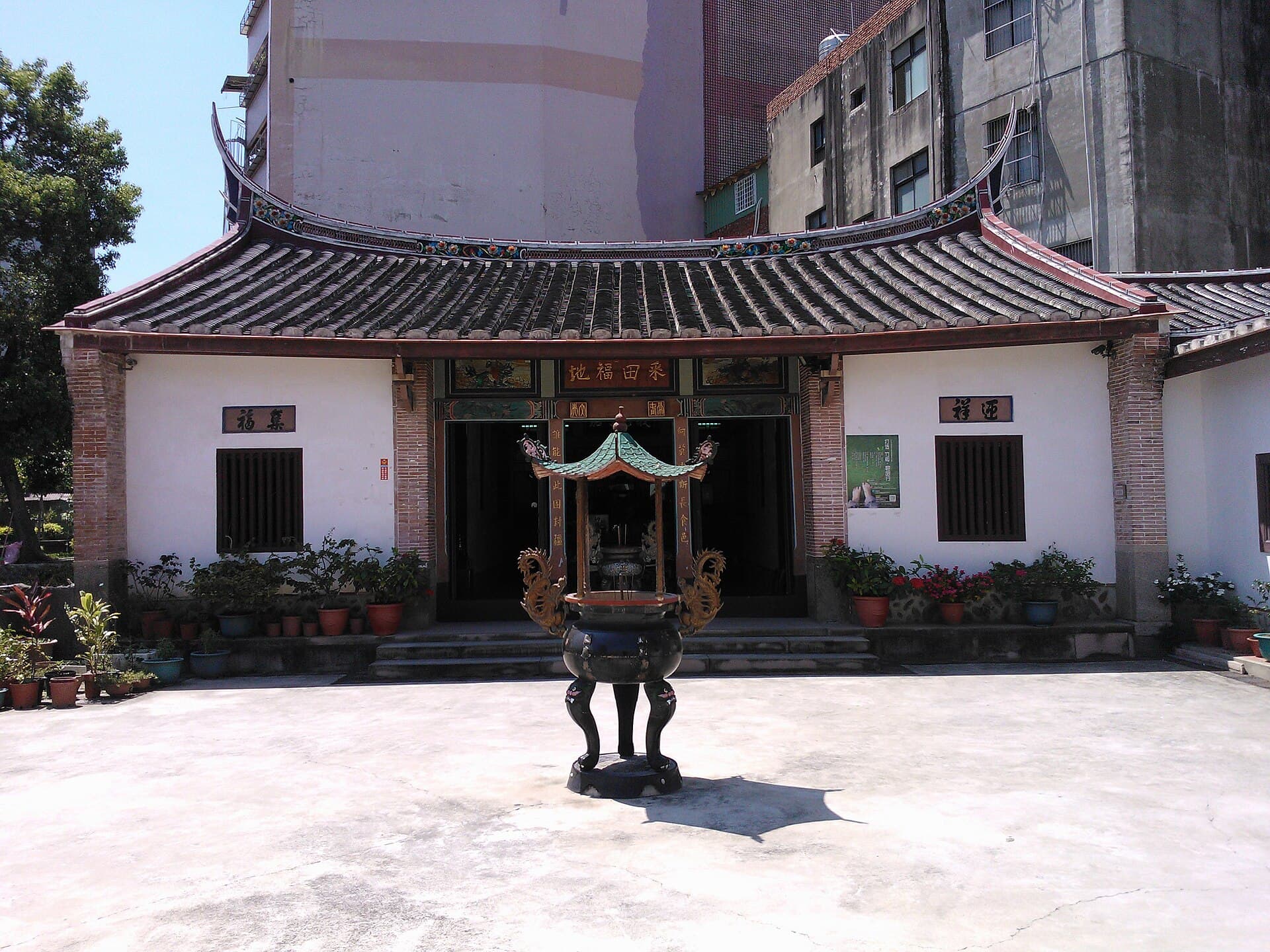
Zhubei Caitian Fudi
Caitian Fudi, formerly known as Zhujian She Gongguan (Public Hall of the Zhujian Indigenous Community) or Caitian Temple, served as the ancestral hall for the seven clans of the Zhujian She indigenous people. The existin…
Visitor Essentials
Caitian Fudi, formerly known as Zhujian She Gongguan (Public Hall of the Zhujian Indigenous Community) or Caitian Temple, served as the ancestral hall for the seven clans of the Zhujian She indigenous people. The existing Caitian Fudi is a single-entrance, three-bay building with a swallowtail ridge and hard-peak roof. While its exterior lacks the luxury and intricacy typically found in Han Chinese ancestral temples, its architectural form is not significantly different. The Pingpu (Plains Indigenous) Zhujian She community was distributed across the Zhujian Plain, extending south to Xiangshan and north to the Zhujian River. In the 21st year of Kangxi (1682) during the Qing Dynasty, when Zheng Keshuang's troops of the Ming-Zheng regime transported military provisions northward, they conscripted the indigenous people. The seven northern indigenous communities rebelled. After their suppression, most Pingpu indigenous people fled into the mountains, with only the Zhujian She community surrendering. They gradually migrated north, settling in the area that would later become Zhujian. In the 11th year of Yongzheng (1733), when Zhujian built a bamboo palisade around its city, the Zhujian She community was ordered to relocate to Jiuzhe (Old Community). During this period, the Pingpu people of Zhujian She assisted the Qing court, defending Taiwan's borders and repeatedly achieving great merits. Consequently, they were granted feudal lands and allotted 'Caitian' (literally 'harvested fields') as their fief, and a public hall was constructed. In the 12th year of Qianlong (1747), some Pingpu people moved to Baliguo (present-day Xinpu), while others, suffering from floods, relocated to Xinshe (New Community) in the 14th year of Qianlong (1749). In the 23rd year of Qianlong (1758), Jue Luo Shiming, the Prefect of Taiwan, ordered the 'Shoufan' (Sinicized indigenous people) to adopt Qing customs by braiding their hair, wearing caps and shoes, and, based on their communities, bestowed upon them seven surnames: Qian, Wei, Liao, San, Pan, Li, and Jin. They also selected a site described as 'three mountains rising centrally, two waters dividing and flowing; Lion's Head on the left, Phoenix's Nose as a screen on the right' to build the ancestral temple for the seven clans, naming it 'Xinshe Gongguan' (New Community Public Hall). Inside the Gongguan, the God of Fortune was enshrined (according to Taiwanese custom, ancestral tablets of non-officials were not allowed to occupy the central position). When the Gongguan was completed in the 25th year of Qianlong (1760), Emperor Qianlong bestowed an imperial plaque inscribed with 'Specially conferred: admirable for bravery and righteousness,' which was hung in the main hall. During the Daoguang era, the Goddess Fuao (Goddess of Wealth) was also enshrined as 'the glory of the indigenous community.' In the 4th year of Xianfeng (1854), coinciding with rampant natural disasters and clan feuds between Fujianese and Cantonese settlers, the hall was destroyed, people dispersed, and the scene was desolate and utterly grim. Although there were proposals to rebuild the Gongguan during the Tongzhi era, they ultimately failed to materialize for various reasons. By the 2nd year of Guangxu (1876), the reconstruction was overseen by indigenous headman Liao Anbang and interpreter Qian Yulai. The originally planned architectural scale was 'a three-bay main hall with four side rooms.' However, due to a shortage of construction funds, money was borrowed from Han Chinese the following year. Qian Yulai later repaid the debt, and the open land in front of the hall was used as compensation, only then was the original appearance restored. Furthermore, due to the principle of 'righteousness derived from land rents, and indigenous people from cultivated fields,' it was named 'Caitian,' and subsequently 'Caitian Fudi.' The recessed main entrance facade consists of three wooden latticework doors. The central solid plank door is painted with door gods. Square doorpins engraved with 'Changchun' (Everlasting Spring) and 'Wenguang' (Literary Brilliance) are affixed above the door lintel, surmounted by a golden horizontal plaque bearing the four characters: 'Caitian Fudi.' The couplets on the doorframe read: 'Why not reside here and enjoy this fiefdom forever, who can abandon this to secure the borders?' Inside the main hall, whitewashed walls and cobblestone foundations give a rough and simple impression, yet the altar retains the elaborate style of Han Chinese ancestral temples. In the center are enshrined the God of Fortune with a full black beard and the benevolent Goddess Fuao. Behind them is a collective ancestral tablet for the seven clans, inscribed with 'Taiwan' as their origin and 'Specially conferred: Brave and Righteous Protectors, Sinicized Indigenous of the Seven Zhujian Clans' in the middle. For the individual clans below, it states 'Deceased Parents/Ancestors,' but only the 'Ancestors of the Qian Clan through Generations' occupies the central position, which is due to Qian Yulai's role in constructing the hall.
Discover the Context
No stories linked yet.
Happening at Zhubei Caitian Fudi
View CalendarNo upcoming events at this venue.