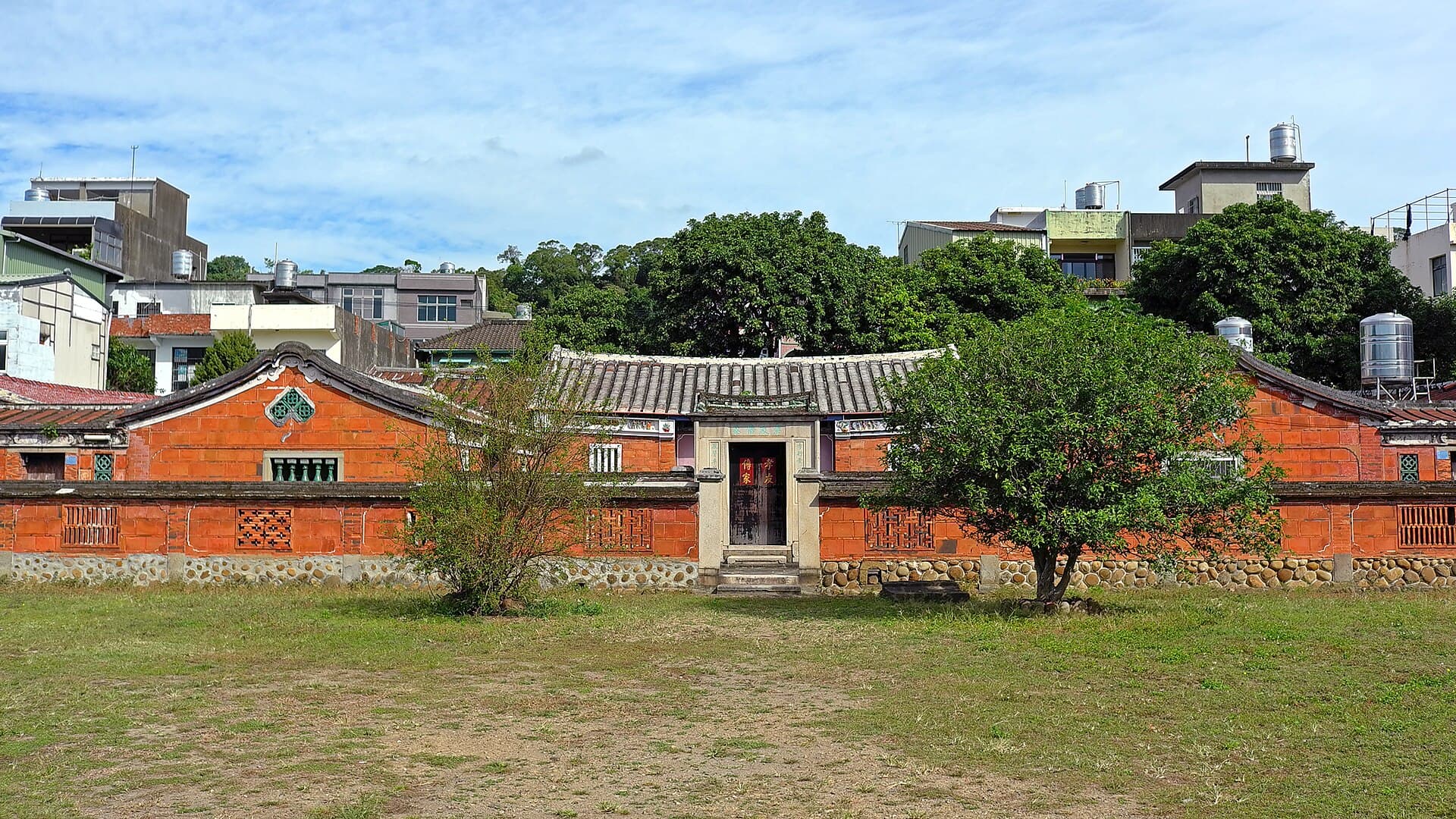
Pan Family Residence in Xinpú
Xinpú is located in the northeast of Hsinchu County, approximately 14 kilometers from the county seat. To its north are overlapping hills, and to its south, it leans against the Fengshan River valley. It is an east-west…
Visitor Essentials
Xinpú is located in the northeast of Hsinchu County, approximately 14 kilometers from the county seat. To its north are overlapping hills, and to its south, it leans against the Fengshan River valley. It is an east-west oriented town, once a newly developed paradise on the "Barigu" wilderness. The Pan Family Residence in Xinpú, also known as Pan's Old House, was built by Pan Shuxian from Wuliting, outside the West Gate of Meixian, Jiaying Prefecture, Guangdong Province, after he migrated to Taiwan and settled in Xinpú, Zhúqiàn. He arrived in Taiwan in the 51st year of Emperor Qianlong's reign (1786). He initially resided in Nanshi, Zhongli, where he became the son-in-law of Yang Xi. However, as Yang only had one daughter, and both mother and daughter died prematurely, his brother-in-law pawned off all of the family property. Consequently, Pan Shuxian was compelled to leave Nanshi and move to Xinpú to start a business in partnership with friends. After successfully establishing his business, he returned to Nanshi with funds, redeemed the pawned family property of the Yang family, and renovated the public ancestral hall. Following the prosperity of his business, Pan Shuxian purchased land and built a residence on the north side of the Fengshan River valley in the 20th year of Emperor Jiaqing's reign (1815). The house was primarily constructed from rammed earth, forming the prototype of the Pan Family Residence in Xinpú. In the 11th year of Emperor Xianfeng's reign (1861), Pan Qinghan and Pan Chenghan, sons of Pan Fúlai (Pan Shuxian's eldest son), reconstructed the residence on its existing foundation. In addition to rammed earth, they extensively used red bricks and granite to create building materials with strong defensive functions, which fully reflected the social order and economic conditions of the time. The Pan Family Residence in Xinpú is situated on a geomantically auspicious "crab's lair" site, located in the central southern part of Xinpú township. It faces south from the north, is backed by mountains and flanked by water, with picturesque scenery. After Heping Street was developed in front of the residence, the original spacious open area was significantly reduced. Busy traffic, coupled with rising local identity and frequent tourist activities, has led to saturation, and the once open and quiet living environment is now densely populated with multi-story buildings and closely built street houses. Improper renovations and visits from petty thieves have further caused this antique and charming private residence to decline and fall into disrepair. Nevertheless, its sturdy framework, rigorous spatial organization, and formidable defensive system remain unique characteristics of this residence. The layout of the Pan Family Residence in Xinpú is a single-entry, three-bay _sanheyuan_ (courtyard house) architectural form with four wing-houses (_hulong_) and double courtyard walls. The gable end of the outer wing-house protrudes one bay further than that of the inner wing-house. The outer and inner courtyard walls are connected to the gable walls of the outer and inner wing-houses, respectively. The space between the two courtyard walls forms an alleyway for residents of the wing-houses to enter and exit. A gate opens in the center of the courtyard wall; the outer courtyard wall features an archway formed by stone gateposts. The wall panels are constructed with various brick-laid openwork windows that allow air circulation but prevent direct visibility. The inner courtyard wall features a single-bay gate built with external stone and internal bricks, topped with a hip-and-gable roof style gate cover made of flat tiles, and a ridgeline decorated with _jiannian_ (cut-and-paste ceramic) figures. The gate facade is inlaid with large granite slabs, a distinctive feature rarely seen in other residences. Above the central gate, an inscription reads: "Filial Piety and Fraternity Passed Down Through the Family." The couplets on the left and right read: "Filial acts universally acknowledged, beyond reproach; a name for friendship well-established, admired by all in the community." The three-bay main hall serves as the place for ancestral tablets and the family's daily living, situated in the most solemn central part of the entire complex. Inside the hall hangs a "Gongyuan" (Provincial Tribute Scholar) plaque, erected by Pan Rongguang in the 11th year of Emperor Xianfeng's reign. The central sections of the two side wing-houses also feature halls, and like the main hall, their main bay facades are recessed. This causes the central axes of the three halls to intersect in the center of the main courtyard (_heping_), and this focal image of the axis is reflected in the paving pattern of the floor. This technique is quite rare, demonstrating the unique craftsmanship and ingenuity in the design of the Pan Family Residence in Xinpú.
Discover the Context
No stories linked yet.
Happening at Pan Family Residence in Xinpú
View CalendarNo upcoming events at this venue.